- Home
- News & Events
- News
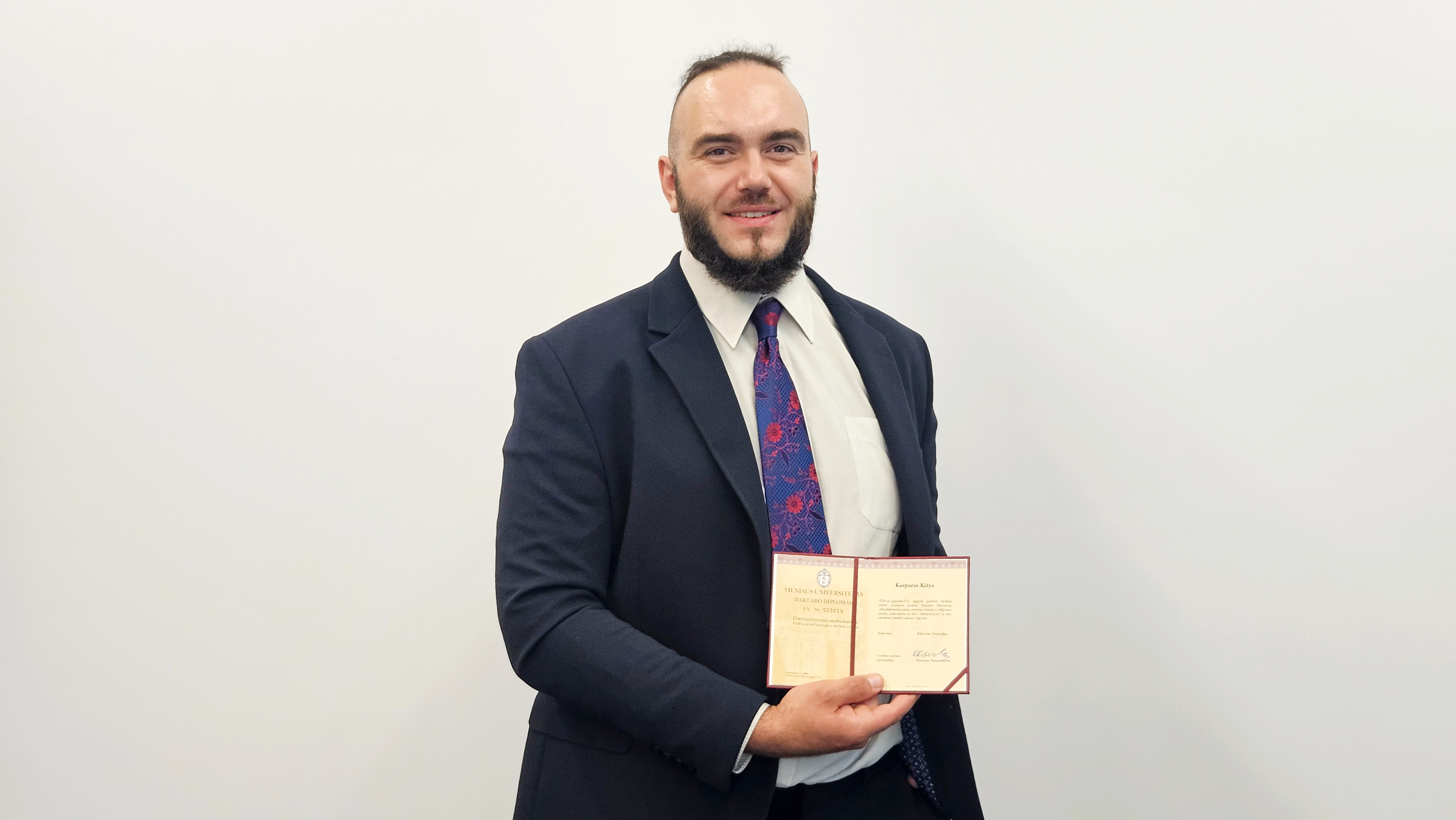
Chemist Kasparas Kižys Earns a PhD for Harnessing Yeast to Generate Electricity
Chemist Kasparas Kižys has successfully defended his doctoral dissertation at the FTMC entitled “Investigation of Bioelectrochemical Systems and Application in Yeast-Based Microbial Fuel Cells” (academic supervisor: Prof. Dr Inga Morkvėnaitė).
The central component of his interdisciplinary research focused on the development of microbial fuel cells (MFC) and the investigation of their potential applications in the fields of energy production and medicine.
In this case, MFC are small devices designed to generate electrical energy from domestic wastewater. “The growing demand for sustainable energy, combined with the need for efficient wastewater treatment, encourages the development of technologies capable of addressing both challenges simultaneously,” Dr Kižys emphasises.
In simple terms, MFC operate as follows: microorganisms “consume” organic matter, and the energy released during this process is converted into electricity. However, as Kasparas notes, this technology is not yet widely applied in practice. The main challenges remain the low amount of electricity generated and unstable performance, largely due to inefficient electron transfer between microorganisms and electrodes.
In his research, the scientist tested innovative approaches. For wastewater treatment, he employed yeast, which is widely used in biotechnology, easy to cultivate, and resistant to environmental stress. To enhance electron transfer, the surface of the yeast cells was modified using two materials: polypyrrole, which forms an electrically conductive layer, and gold nanoparticles, which create additional pathways for electron transport.
Importantly, this system was tested for the first time in real wastewater sludge, rather than solely under laboratory conditions. In addition, an advanced technique – scanning electrochemical microscopy – was used to observe processes occurring in living cells.
According to Dr Kižys, the objectives of the study were successfully achieved. Compared with previous research, the newly developed MFC approach demonstrated significantly improved performance: electricity generation from wastewater increased by approximately two to three times. These results open promising opportunities for further work towards the development of efficient and environmentally friendly energy systems.
Congratulations to Kasparas, wishing him every success in his future scientific career!
The doctoral dissertation can be accessed via this link.
Source: FTMC