- Home
- News & Events
- News
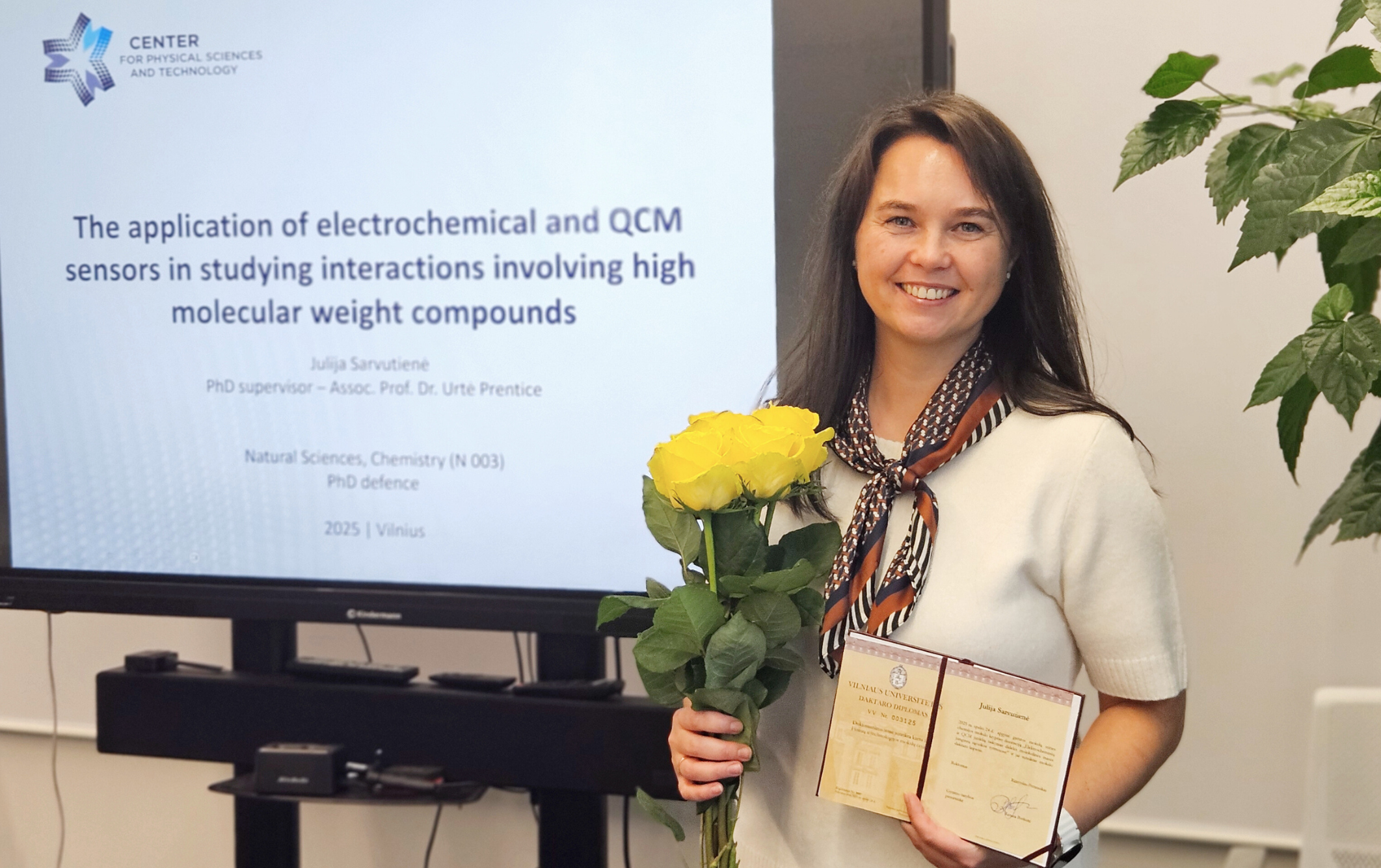
Creating Sensors for Medicine, Julija Sarvutienė Earns Her PhD
Julija Sarvutienė, the scientist from the FTMC Department of Nanotechnology, will always remember 24 October with a smile, the day she defended her dissertation and became a PhD.
The topic of the chemist’s work was “The Application of Electrochemical and QCM Sensors in Studying Interactions Involving High Molecular Weight Compounds” (academic supervisor: Associate Professor Dr Urtė Prentice).
Congratulations to our colleague – wishing inspiration and the very best of success to continue important research!
In her dissertation, Julija aimed to develop biosensors capable of detecting both genetic and immune system changes. Two key proteins were employed for this purpose – T7 DNA polymerase and B-Cell Activating Factor (BAFF). The scientist explored methods to attach these proteins to the sensor surface while preserving their activity.
“I investigated how proteins interact with DNA, but I approached these processes from a different angle – electrochemically, using sensitive surface sensors. While the molecular basis of these interactions has long been known, electrochemical studies allow us to observe and analyze them in a new way – directly, without additional labels or dyes, thus preserving natural conditions,” explains Dr Sarvutienė.
The chemist adds that such biosensors could have broad applications in medicine: for early disease diagnosis, immune system research, and the development of new drugs.
“What gives me the greatest satisfaction is that the idea has become a working result – we managed to create stable sensors capable of precisely detecting protein-DNA interactions. This is a new step towards more accurate and reliable biosensors, applicable both in fundamental research and in medicine,” says the new PhD.
You can read the dissertation by clicking this link
Info: FTMC