- Home
- News & Events
- News
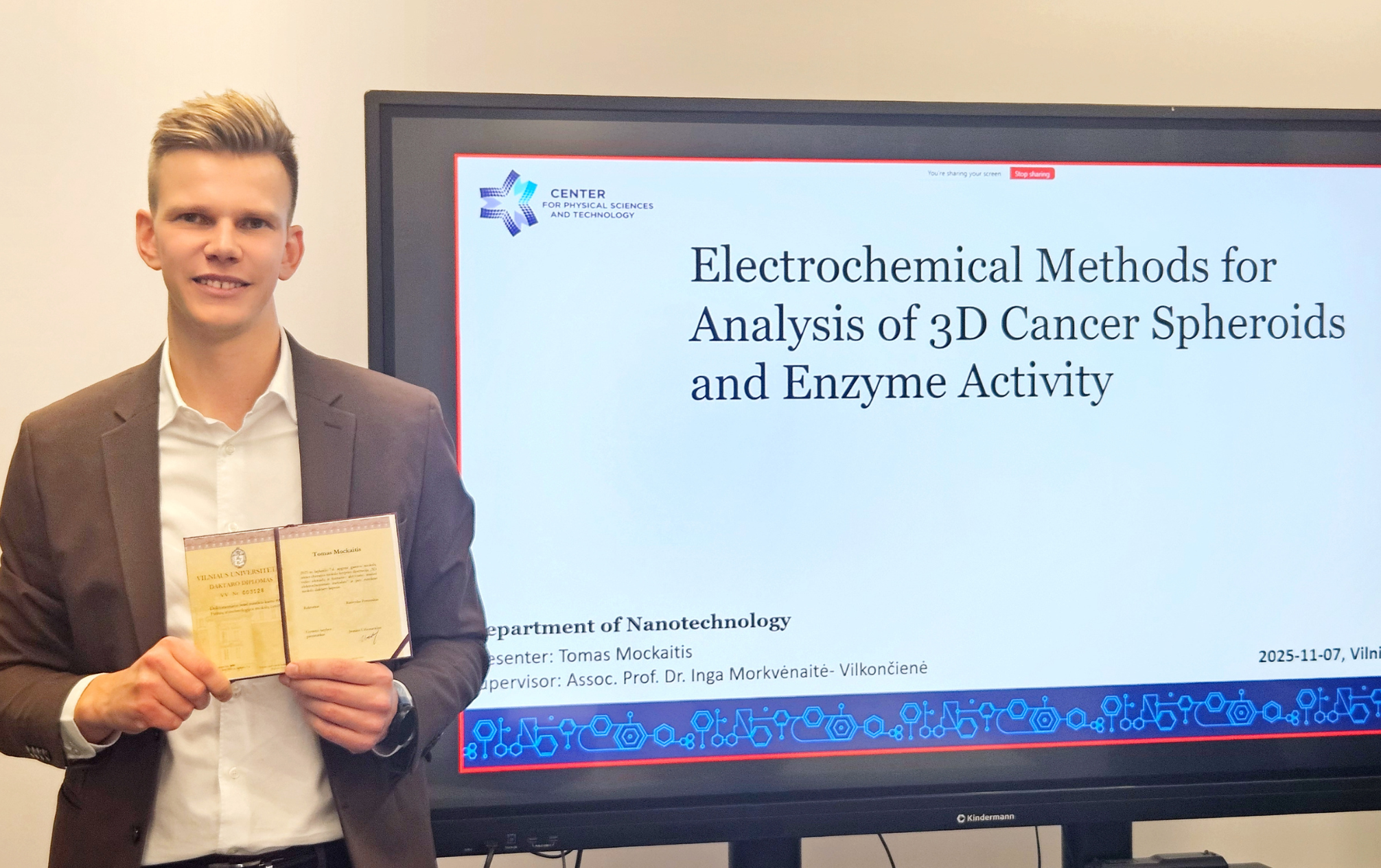
Detecting Cancer Could Soon Become Much Faster: Chemist Tomas Mockaitis Earns His PhD
Cancer remains one of the greatest health challenges of our time. Despite significant scientific progress, early diagnosis of the disease is still difficult, as most forms of cancer cause no symptoms in the initial stages and therefore go unnoticed. As a result, the illness is often detected too late, making treatment more complex.
What can be done to change this? Dr Tomas Mockaitis, a chemist at the FTMC Department of Nanotechnology, aims to develop a biosensor accessible to everyone. The successful results of his research became the basis of his doctoral thesis, which he defended on 7 November. The topic of his work is “Electrochemical Methods for Analysis of 3D Cancer Spheroids and Enzyme Activity” (academic supervisor: Assoc. Prof. Dr Inga Morkvėnaitė-Vilkončienė).
“The dissertation explores new electrochemical methods capable of detecting and diagnosing cancerous cells at an early stage. The goal was to develop a biosensor that could identify cancer biomarkers. Such a device would be inexpensive, affordable, and could be used by patients themselves without the need to visit a healthcare facility,” explains the chemist.
For his research, he used a clinically relevant cancer biomarker – the enzyme Vanin-1, elevated levels of which are associated with various types of cancer. For studies involving three-dimensional cell structures – 3D spheroids – he worked with the widely used MCF-7 breast cancer cell line.
All experiments were based on electrochemical methods, chosen for their high sensitivity, low cost, and suitability for producing very small devices. It is hoped that once this technology is further refined, it will be possible to create specific biosensors. For now, the experiments have shown excellent results.
“It’s gratifying that the developed system worked and that we managed to detect the cancer biomarker in human blood and urine,” says the new PhD.
We warmly congratulate our colleague and wish him every success as he continues this important research!
You can read the full dissertation via this link.
Info: FTMC