- Home
- News & Events
- News
FTMC and Taiwanese Scientists Develop Molecular Probe to Enable Faster Detection of Liver Cancer
Liver cancer will be detectable significantly faster and more accurately thanks to a new-generation sensor supported by a specialised molecular probe. This is the goal set by Dr Antanas Zinovičius, the FTMC Department of Nanotechnology researcher, who is currently collaborating with colleagues from the National Taipei University of Technology (Taipei Tech).
The first experiments carried out by Dr Zinovičius and his colleagues, focused on the early diagnosis of pancreatic and thyroid cancer, have already shown promising results and were published in the international scientific journal Biosensors and Bioelectronics. Why is this research significant?
How to “trick” a cancer enzyme
As the number of liver cancer cases continues to rise worldwide, early and accessible diagnosis is becoming increasingly important. The chemist shares his idea.
“Our aim is to develop a medical biosensor that could be used by anyone at home. It should be as simple to use as possible and require no specialist training. The technology would work in a similar way to a blood glucose test, where a few drops of blood provide quick information. In our case, however, the blood would reveal whether there is an excess of enzymes that indicate liver cancer,” explains Zinovičius.
At present, the process is as follows: we visit a clinic, are prescribed a blood test, give a blood sample and receive the results the next day. In addition, laboratory testing involves preparatory steps – various blood processing procedures – and the more steps there are, the higher the probability of error. We want to eliminate those steps so that, at home, within half an hour, we can find out whether the risk of liver cancer is increased,” adds the scientist.
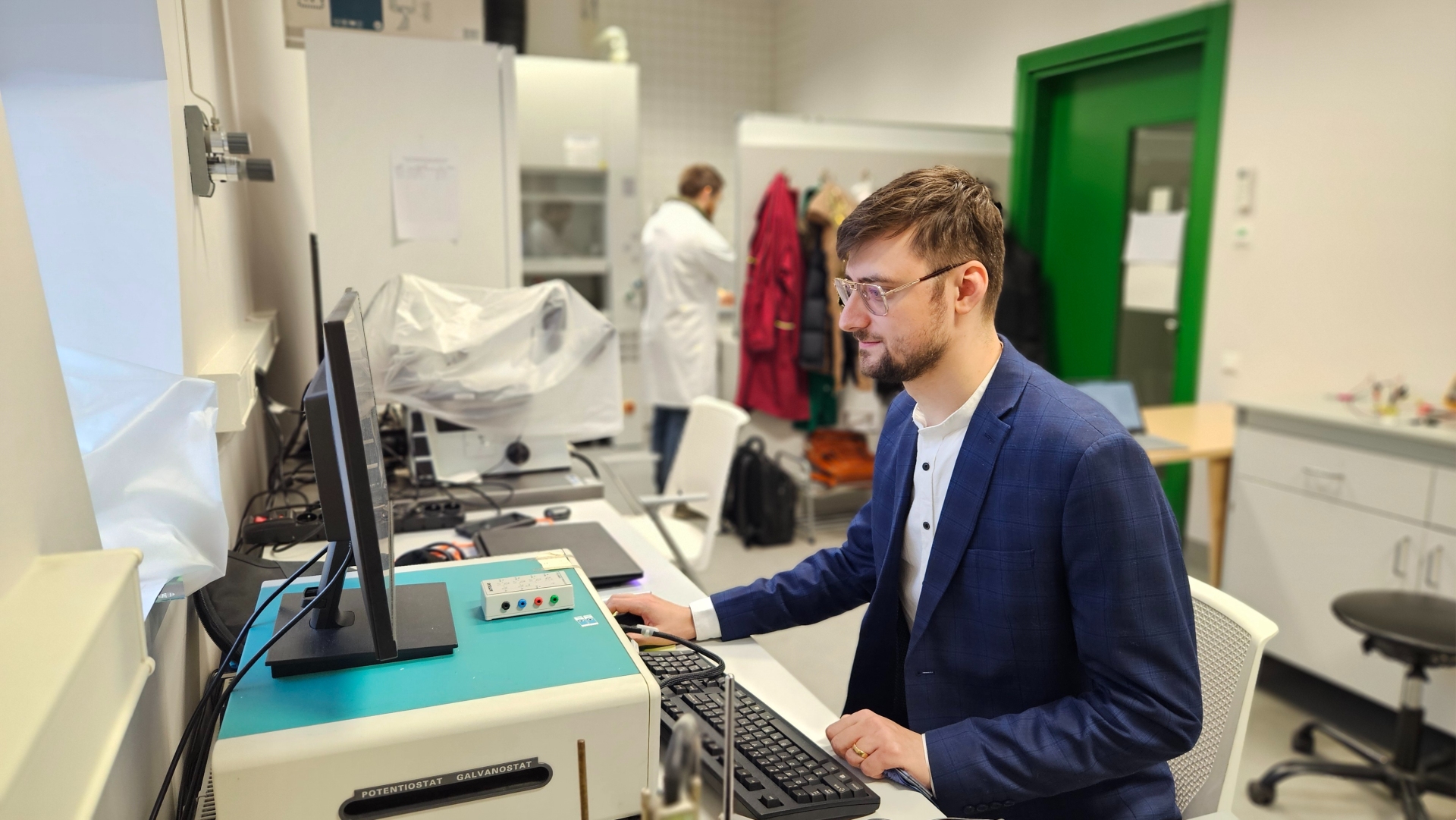
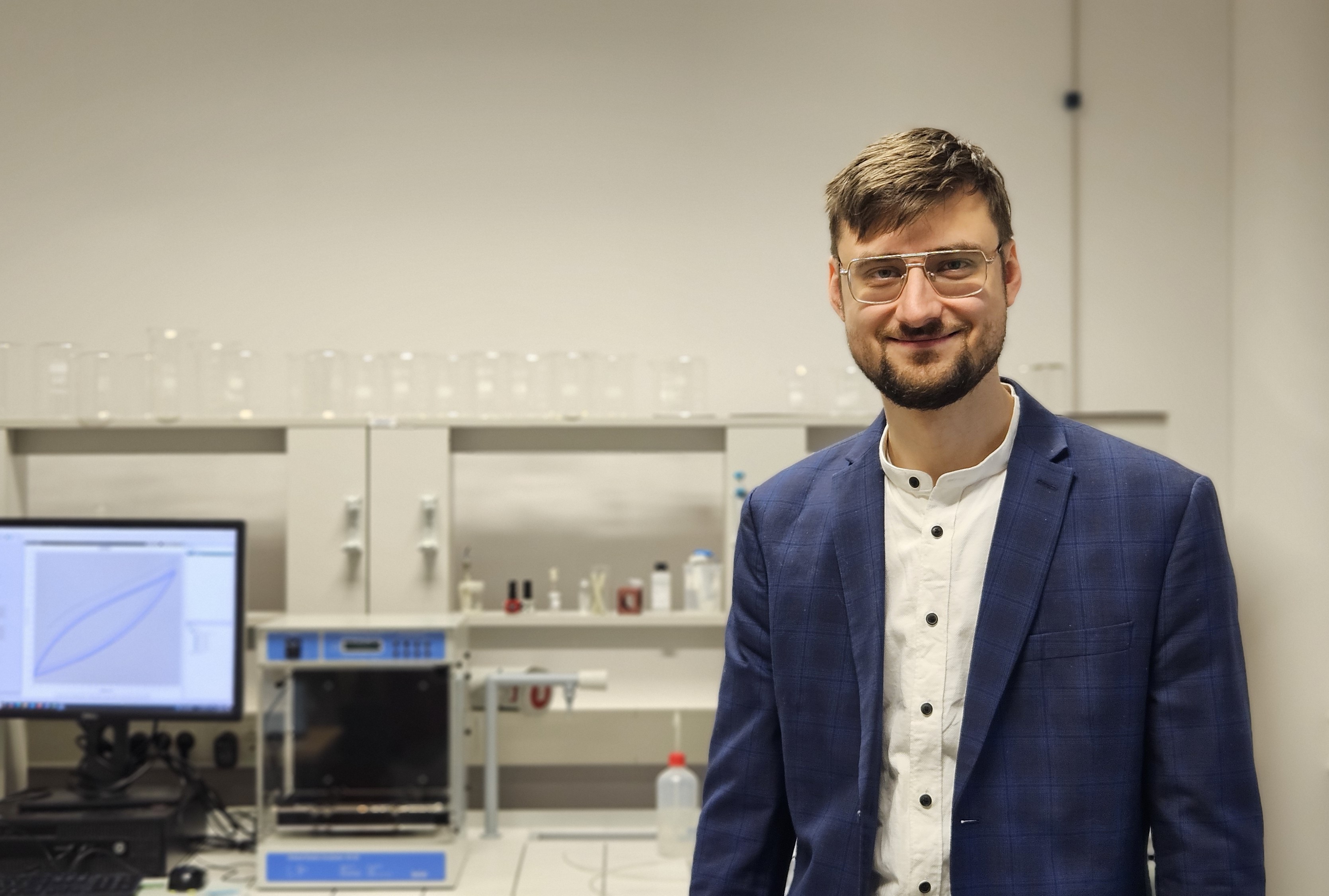
(Dr Antanas Zinovičius. Photo: FTMC)
To ensure the sensor functions accurately, FTMC and Taiwanese scientists are developing a special probe made of molecules. How does it work? A chemical compound called ferrocene is attached to an organic (carbon-based) molecular chain. Its role is crucial.
According to the concept, a liquid containing this material – the probe – is added to a patient’s blood sample. If there are no cancer-indicating enzymes present in the blood, nothing happens and the sensor receives no signal.
However, if cancer is present, the process unfolds differently: a blood enzyme, recognising the artificial molecular chain, begins to “digest” it, mistaking it for “natural food”, and cuts it in half. One part floats freely, while the other – the ferrocene – performs its task. Ferrocene is an excellent electron carrier, so it sends an “electrochemical message” to the sensor’s electrode indicating that the probe has been cleaved – meaning liver cancer has been detected.
According to Dr Zinovičius, the research team ultimately plans to develop four separate probes to “trick” different liver cancer enzymes. Initially, however, they aim to test the technology using just one enzyme – dipeptidyl peptidase-IV.

(Dr Antanas Zinovičius with his colleagues from Taiwan. Photo from a personal archive)
Hopes for business interest
At present, experiments are being conducted using chicken blood, as it contains no liver cancer enzymes at all. “Whatever amount you add is exactly what will be there. This allows us to know the precise concentration and later compare it with the information obtained from the biosensor,” explains the FTMC researcher.
Later, the technology will also be tested using human blood, as was successfully done in Taiwan when developing the first probe for pancreatic and thyroid cancer diagnostics, described in the aforementioned Biosensors and Bioelectronics journal.
Currently, the work continues in Vilnius, where efforts are focused on improving probe creation processes and achieving better results.
During his doctoral studies at VILNIUS TECH, Dr Zinovičius developed a universal immunosensor capable of indicating not only “positive” or “negative” results, but also the exact concentration of a substance. To amplify the signal, the chemist employed gold and platinum nanoparticles as well as reduced graphene oxide – an ultra-thin, nearly one-atom-thick carbon layer that conducts electricity very efficiently. The result was a sensor prototype ten times more accurate than conventional ones, delivering results within 20 minutes.
With the support of Taipei Tech, both the probe and the dedicated sensor are now being further refined.
“At this stage, we are working from a fundamental research perspective, checking whether everything functions as intended. We hope our work will be noticed and appreciated by businesses, enabling our technology to be applied in medical practice,” says Dr Zinovičius.
Written by Simonas Bendžius, FTMC Public Relations and Communication Specialist