- Home
- News & Events
- News
25 June, 2025
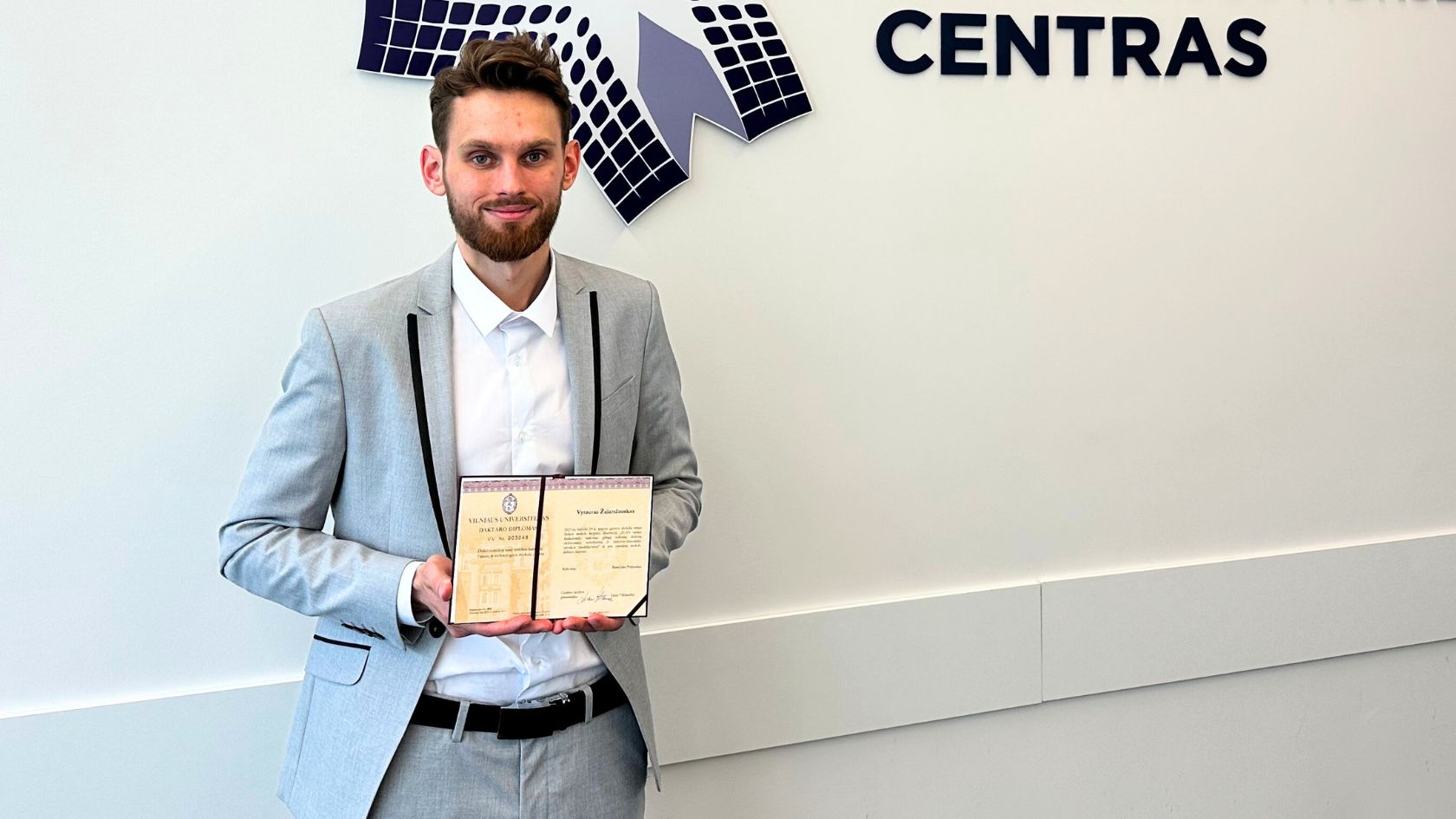
FTMC Continues to Lay the Foundations for Quantum Technologies: Physicist V. Žalandauskas Defends His PhD
Vytautas Žalandauskas, a physicist at the FTMC Department of Fundamental Research, defended his PhD on 19 June. His topic is ‘Application of the SCAN Density Functional for Modelling Electronic Excitations and Electron-Phonon Interactions of Point Defects in Semiconductors’.
Academic supervisors: Dr Lukas Razinkovas and the late Prof. Dr Audrius Alkauskas.
Congratulations to our colleague and best wishes for success in paving the way for quantum technologies!
Vytautas' thesis analyses how a certain theoretical computational method (called the SCAN density functional) can be used to model tiny point defects in semiconductor crystals such as diamond, silicon, and 4H silicon carbide. Such defects can act as quantum bits (qubits) or sources of single photons - which are essential components for the development of quantum technologies such as quantum computers, communications or sensors.
"The accuracy and performance of the recently developed SCAN density functional has been compared with commonly used GGA and hybrid functionals in modelling the electronic, vibrational and vibronic properties of point defects in the materials studied.
The identification and investigation of point defects suitable for quantum applications requires a theoretical basis for accurate and efficient prediction of their electronic and optical properties. Our group uses and develops advanced electronic structure computation methods based on density functional theory to help identify and characterise point defects suitable for quantum applications," says Žalandauskas.
According to the physicist, the thesis shows that SCAN methods can accurately calculate how the materials under study absorb and emit light - as well as or better than with much more sophisticated and costly methods.
It was also possible to simulate light spectra from scratch that closely matched real experimental data, even though it required several times less computational resources. This proves that SCAN methods are reliable and efficient when it comes to studying point defects in solid materials, such as crystals for quantum technologies.
Info: FTMC