- Home
- News & Events
- News
FTMC Researchers Win Gentec-EO Laser Lab Awards Instrument
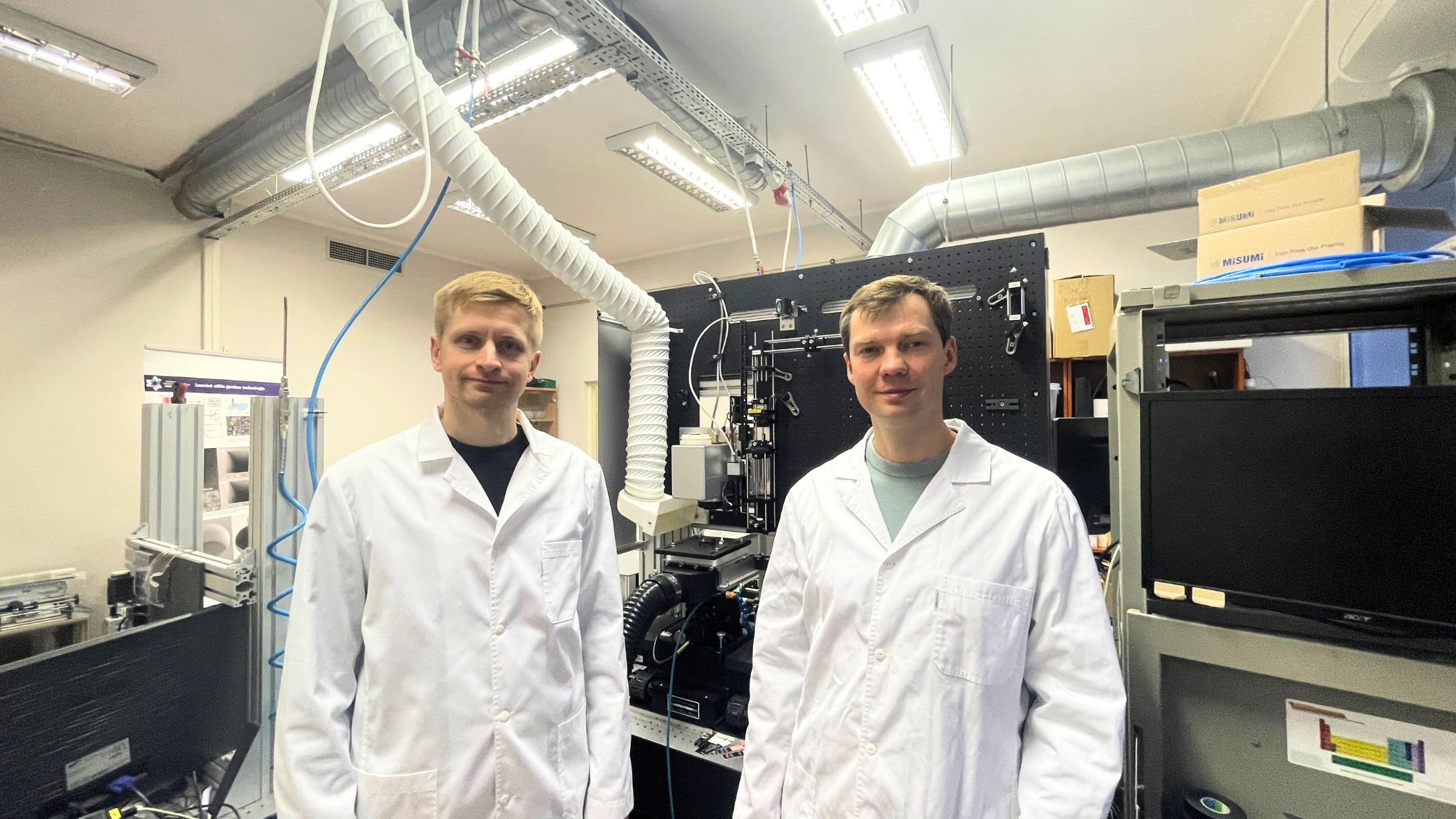
Dr Paulius Gečys and Dr Juozas Dudutis from FTMC Laser Microfabrication Laboratory have been selected as one of the winners of the Gentec-EO Laser Lab Awards. As part of this award, the laboratory has received a UP19K-15S-H5-BLU-D0 laser power detector, which will contribute significantly to ongoing research activities.
“The Gentec-EO Laser Lab Awards initiative supports university and research laboratories worldwide by providing access to high-quality laser measurement instruments commonly used in industry. Its mission is to help students and researchers work with the same advanced tools that drive modern photonics technologies,” says Gečys.
He with colleague submitted their research project “Glass processing using bursts of ultrashort laser pulses with spatially structured beams”, which was selected for support. The project focuses on developing advanced laser processing technologies for transparent materials using short and ultrashort pulse bursts, combined with spatially structured beams.
The research aims to:
- Develop methods for laser beam shaping and longitudinal intensity control using binary amplitude filters.
- Create tailored Bessel beams with various intensity profiles to better control energy deposition inside transparent media.
- Advance understanding of light–matter interaction in burst-mode processing, enabling faster and more efficient micromachining.
- Expand the application potential of state-of-the-art ultrashort pulse and high-repetition-rate laser sources developed in Lithuania.
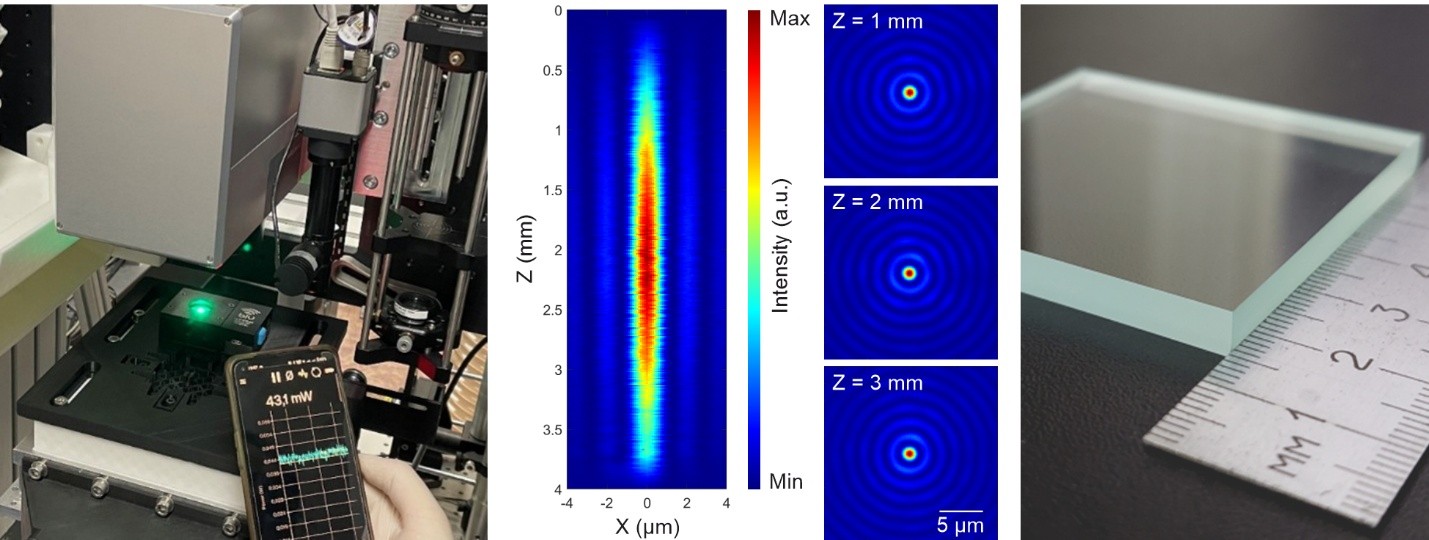
(Laser power measurement with UP19K-15S-H5-BLU-D0 detector, example of conventional Bessel beam profile characterization with BEAMAGE 4M beam profiler and glass dicing application with Femtolux 30 femtosecond laser. Photos: FTMC)
The awarded power detector UP19K-15S-H5-BLU-D0 will complement the existing BEAMAGE 4M beam profiler in the laboratory. Together, these instruments will be essential for:
- Characterizing spatially structured Bessel beams, including propagation dynamics.
- Measuring laser power and pulse energy at different stages of the optical setup – an especially critical parameter in intra-volume glass modification experiments.
- Supporting experiment planning and ensuring precise, repeatable processing conditions.
The wireless design of the new detector will further simplify experimental workflows.
“This equipment will be used extensively not only in this project but also across other FTMC research activities. It is expected to support the work of Master and Bachelor students, contribute to several ongoing and future research projects, and play a role in scientific publications,” explains Gečys.
Congratulations to Dr Paulius Gečys, Dr Juozas Dudutis, and the entire Laser Microfabrication Laboratory team for this achievement and for continuing to strengthen FTMC position in advanced laser technologies!
The researchers also express their thanks to Gentec-EO, Standa, and Ekspla for support.
FTMC information