- Home
- News & Events
- News
17 July, 2025
FTMC Scientists to Analyze Russian Drone Handed Over by “Blue/Yellow”: Science Contributes to Defence
A growing question in public discourse is whether Lithuania is prepared to defend itself against hostile drones. Scientists at the Center for Physical Sciences and Technology (FTMC) are working to answer this question, now with a unique opportunity in hand – they have received a Russian drone “Gerbera”, transported from the battlefield in Ukraine, for in-depth research.
The drone was handed over to FTMC by the initiative of NGO Blue/Yellow, which supports Ukraine. This device, used against Ukrainian defenders, is now in the hands of Lithuania’s largest scientific research institution. FTMC believes that studying this unmanned aerial vehicle (UAV) will deepen our understanding of how such systems operate and help develop technological solutions to counter hybrid threats in the future.
“This is more than scientific curiosity – it’s our contribution to national security. By understanding enemy technologies, we become stronger,” says Dr. Reda Nausėdaitė, FTMC Deputy Director for Innovation and Development.
Blue/Yellow co-founder Jonas Ohman emphasizes that the decision to hand over the drone to FTMC scientists stems from a clear goal – to strengthen Lithuania’s defence capabilities:
“Given the rapid development of modern warfare technologies, we believe that collaboration between science and civic initiatives is essential. The more we know about enemy technological capabilities, the better positioned we are to craft an effective response to potential threats,” Ohman states.

Jonas Ohman, Co-founder of Blue/Yellow. FTMC photo.
FTMC aims to better understand the technologies used on today’s battlefield and how this knowledge could support the strengthening of Lithuania’s defence sector.
“Drone technologies are evolving rapidly. Having access to a real, battlefield-used UAV allows our researchers to delve into unfamiliar systems, assess the risks they pose, and develop advanced technologies,” explains Dr. Nausėdaitė.
According to her, the field of drone technologies demands extreme adaptability and continuous learning:
“Today, we are investing in strengthening scientific knowledge and practical expertise so that tomorrow we can develop solutions to protect Lithuania – from understanding how such systems work to the ability to neutralize them quickly or build our own.”
The opportunity to study a drone used in actual combat not only contributes to national security but also enhances the researchers’ competencies by analyzing a real-world technical device and its data.
“This is an extraordinary chance for our scientists to work closely with technologies of modern warfare. Such hands-on experience is crucial for building high-level expertise, which is becoming increasingly vital in defence and national security,” says Dr. Nausėdaitė.

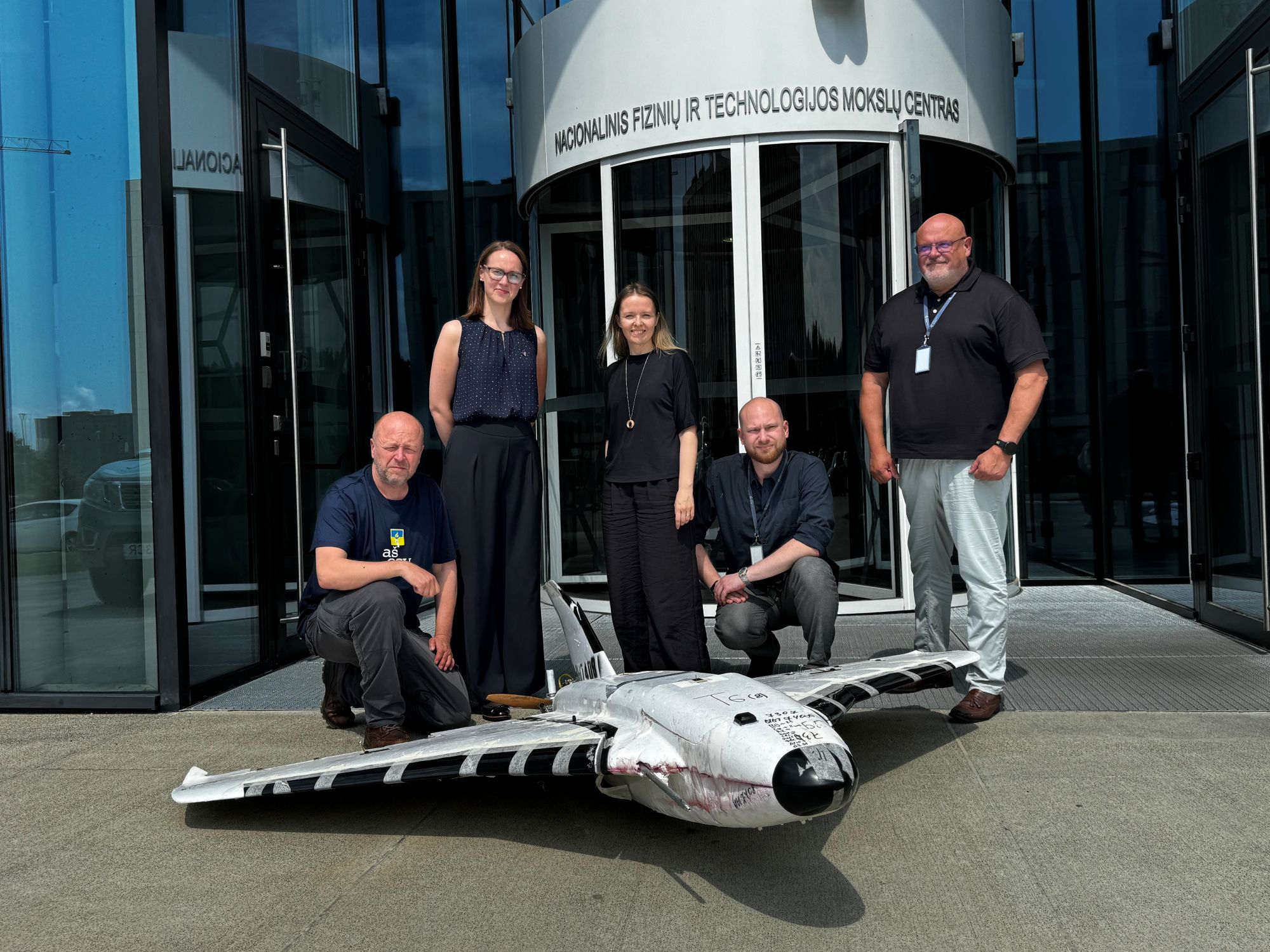
Group photo of FTMC and Blue/Yellow representatives with the drone at FTMC. FTMC photo.
FTMC views such research as a significant contribution to national security, as today’s technological advantage is tomorrow’s security guarantee. It shows that Lithuanian science is keeping pace with the defence sector, and the knowledge gained in laboratories is gaining real-world value in the face of possible threats.
To support Ukraine’s frontline, Blue/Yellow has purchased over 5,000 drones and related equipment since the beginning of the invasion. The organization’s latest campaign – “Dronathon” – aims to raise €1 million within two months to purchase more drones. Since its founding in 2014, Lithuanians have donated €100 million to Ukraine through Blue/Yellow.
FTMC information