- Home
- News & Events
- News
How Metal 3D Printing Helps Maintain the Precision of High-Power Lasers: FTMC Proposes a New Solution
Sometimes, a laser can be destabilised not by a mechanical impact, but by just a few unevenly distributed degrees of heat. As components warm up, they may deform, shift the position of optical elements, and disrupt the operation of the entire system.
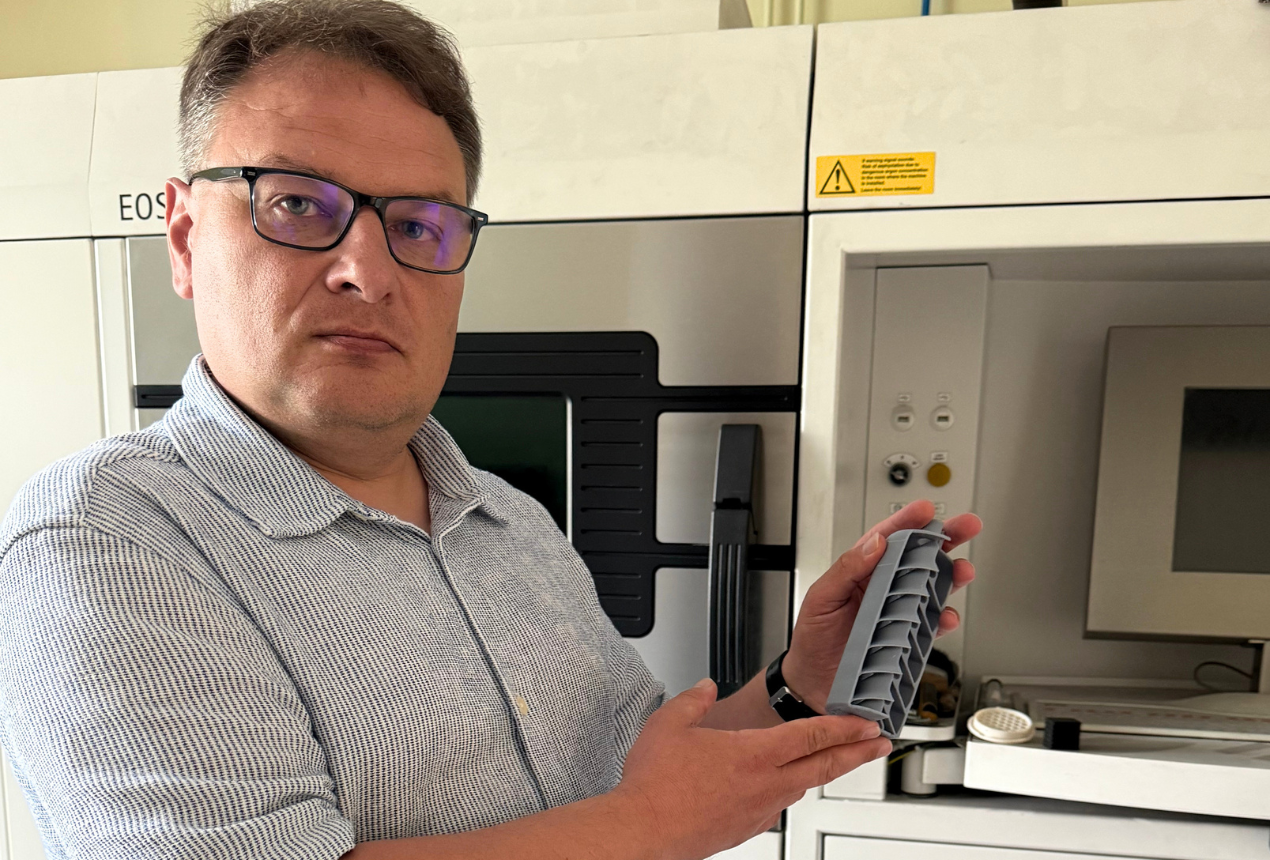
The 3DLab team at the Laboratory of 3D Technologies and Robotics, part of FTMC’s Department of Laser Technologies, is addressing this challenge in practical terms by designing and manufacturing metal components with integrated internal cooling channels. These capabilities are currently being applied in the international LASER-PRO project, where FTMC works together with Czech partners HiLASE Centre and CARDAM to develop thermal management solutions for advanced laser systems.
When the Inside of a Component Matters Most
Metal components are usually milled, drilled, or assembled from several separate parts. However, these conventional methods do not always allow engineers to create complex channels deep inside a component. Metal 3D printing offers a different approach. By building a component layer by layer, engineers can form spiral, branching or multi-channel pathways inside it and direct coolant precisely to the areas exposed to the highest thermal loads. Put simply, the principle is like a carefully designed network of pipes hidden inside a building’s walls: it may be almost invisible from the outside, but it is essential for the stable operation of the entire system.
“In high-power laser systems, the challenge is not only to remove the heat that is generated, but also to ensure that temperature changes do not deform the components or misalign the optical system. Metal 3D printing allows our team to create complex internal cooling channels and integrate functions within a single component that are often impossible to achieve using conventional manufacturing methods. The practical benefit is more compact, stable and reliable laser systems capable of operating over long periods,” says Dr Genrik Mordas, Senior Researcher at FTMC’s 3DLab.
From a Digital Model to a Metal Prototype
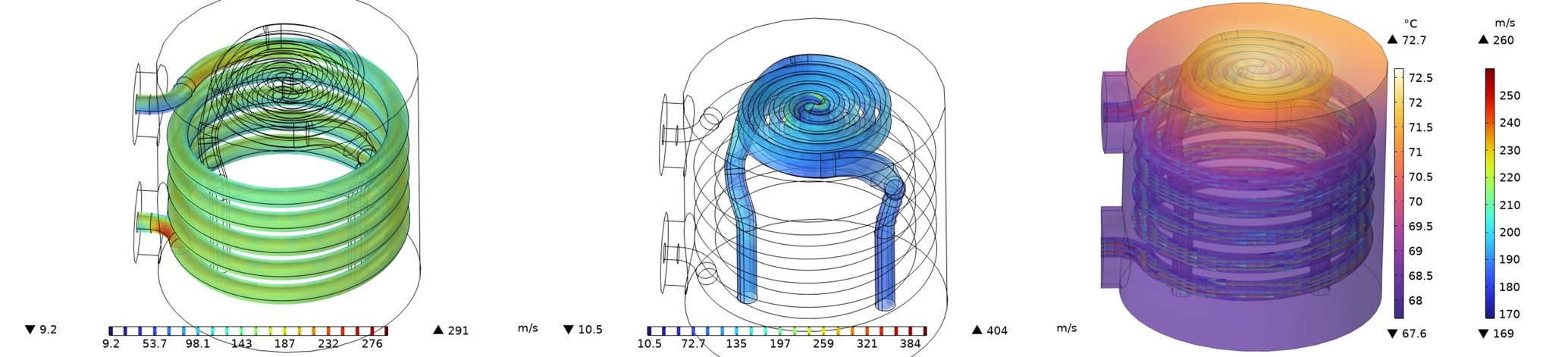
One of FTMC 3DLab’s key strengths is its ability to carry out the entire technological workflow in one place. First, the component is designed digitally. The team then models how coolant will flow through it, how heat will be distributed and whether the component will remain mechanically stable. The part is subsequently manufactured using the EOS M280 metal 3D printing system and evaluated in the laboratory. This process makes it possible to move beyond a theoretical model. A solution can be physically produced, tested, assessed and further improved based on the results. FTMC PhD researcher Karolis Stravinskas is working on optimising the metal 3D printing process, manufacturing the components developed within the project, evaluating their quality and improving the designs together with the team. As part of LASER-PRO, the FTMC team is developing cooling plates, laser beam absorbers, air-cooling elements and housings with integrated cooling channels.
From a Laboratory Solution to Real-World Application
FTMC 3DLab has already developed an air-cooled metal mirror for high-power laser systems. This example demonstrated that metal 3D printing can be used not only for rapid prototyping, but also for functional components in which thermal management, mechanical stability and compact design are addressed simultaneously.
This is where the “from lab to market” value becomes clear. An idea developed in the laboratory passes through several stages:
digital model → simulation → metal prototype → experimental evaluation → solution prepared for practical application
In the future, such components could support the development of more compact, stable and reliable laser systems capable of operating for longer periods.
Applications Beyond the Laser Industry
Efficient thermal management is important wherever high power is concentrated within a limited space.
Similar 3D-printed components may therefore be relevant to semiconductor manufacturing equipment, electronics cooling, space technologies, medical devices, defence systems and other high-value engineering applications.
By the end of the LASER-PRO project, the partners aim to develop and validate a new generation of thermal management demonstrators for laser systems.
In this context, 3D printing becomes more than a manufacturing method. It enables engineers to design a component according to its intended function: how coolant should flow, how heat should dissipate and how the entire system should remain stable.
Learn more about the solutions being developed within LASER-PRO on the project website.
About the project

The solutions presented in this article are being developed within the international LASER-PRO Excellence Hub project.
Project number: 101186838
Funding: Funded by the European Union.
The LASER-PRO and European Union logos should be displayed alongside this information. Views and opinions expressed are however those of the author(s) only and do not necessarily reflect those of the European Union or the European Research Executive Agency (REA). Neither the European Union nor the European Research Executive Agency (REA) can be held responsible for them.