- Home
- News & Events
- News
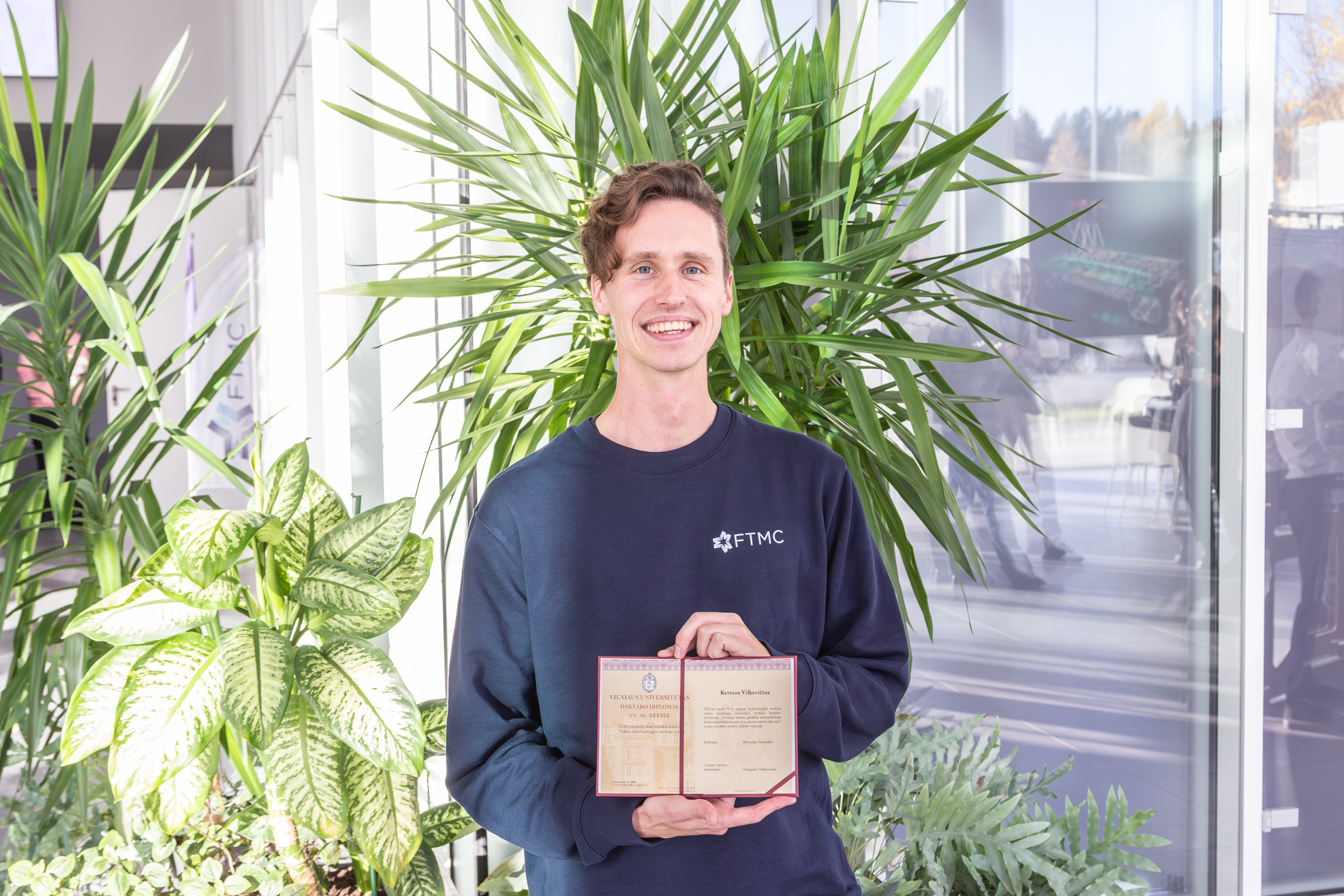
Kernius Vilkevičius Uses Laser Pulses to Create Nanostructures That Control Light: FTMC Researcher Earns a PhD in Technological Sciences
Dr Kernius Vilkevičius, a researcher in the Laser Technologies Department at FTMC, has successfully defended his doctoral dissertation entitled “Nanoengineering of Noble Metal Gratings Using a Femtosecond Laser and Their Plasmonic Applications” (supervisor: Dr Evaldas Stankevičius). His research explores how ultra-short laser pulses can be used to create nanostructures on gold and silver surfaces and how these structures can be used to control light. The findings could contribute to the development of more sensitive optical sensors and advanced material analysis technologies.
When light reaches the surface of a material, it can be reflected, absorbed or concentrated within a small area. How light behaves depends not only on its source but also on the properties of the surface. One way to control these processes is to modify the structure of the surface itself.
This can be achieved using nanostructures – extremely small features measuring just a few billionths of a metre. Despite their tiny size, they can significantly alter how light interacts with a material.
Plasmonic structures are particularly interesting in this respect. When light interacts with metal nanostructures of a particular shape, free electrons on their surface begin to oscillate collectively. These collective electron oscillations are known as surface plasmons. This phenomenon makes it possible to enhance the interaction between light and matter and concentrate light within an extremely small area.
“My dissertation focuses on how ultra-short laser pulses can be used to create nanoscale structures on the surfaces of noble metals, such as gold and silver, and how these structures change the way light interacts with matter. By carefully shaping these nanostructures, we can control how light is reflected, absorbed and concentrated. My research examined the fabrication of structures with different shapes, their optical properties and their potential practical applications,” explains the researcher.
One promising application of these nanostructures is the development of highly sensitive optical sensors. They could help detect even very small changes in the surrounding environment, such as variations in the refractive index of liquids or gases. The refractive index describes how light travels through a particular material. Changes in this value can provide information about the composition or properties of the material being analysed.
Such sensors could be used to detect chemical and biological substances, analyse different liquids and monitor environmental parameters.
Another important area of research is concentrating light within an extremely small area. Metallic nanostructures can enhance the interaction between light and matter, making it easier to observe very subtle optical phenomena, such as light scattering. This is particularly relevant to spectroscopic analysis – the study of how materials interact with light to determine their composition. This approach could help detect even very small quantities of proteins, viruses or biological markers.
“The potential applications of these structures depend on their shape. One geometry may be better suited to one application, while another may be more effective for a different purpose. That is why it is important not only to be able to create nanostructures, but also to understand how their geometry determines their optical properties,” says K. Vilkevičius.
The dissertation is based on six scientific publications and one national patent. The research findings presented in three of the researcher's papers were also featured on the covers of scientific journals.
“What I am most pleased about is how productive my doctoral studies have been – both in terms of the research carried out and the results achieved, as well as their presentation at conferences. It is rewarding to see that our research has not only scientific but also technological value and potential,” says Kernius.
Source: FTMC