- Home
- News & Events
- News
LASER-PRO Partners at Optica Laser Congress 2026: From Advanced Optics to High-Power Laser Applications
Held in Vilnius on 11–15 October, the international „Optica Laser Congress and Exhibition 2026“ brought together researchers in laser physics, photonics and engineering, as well as industry representatives. The event covered a range of topics, including high-power laser technologies, advanced optical coatings, ultrashort light pulses and laser-driven X-ray sources.
For LASER-PRO partners - the Center for Physical Sciences and Technology (FTMC), the HiLASE Centre and the European Extreme Light Infrastructure (ELI ERIC) - the congress provided an opportunity to present research findings and share knowledge about emerging applications of laser technologies.
FTMC: Nanostructured Coatings for High-Power Laser Optics
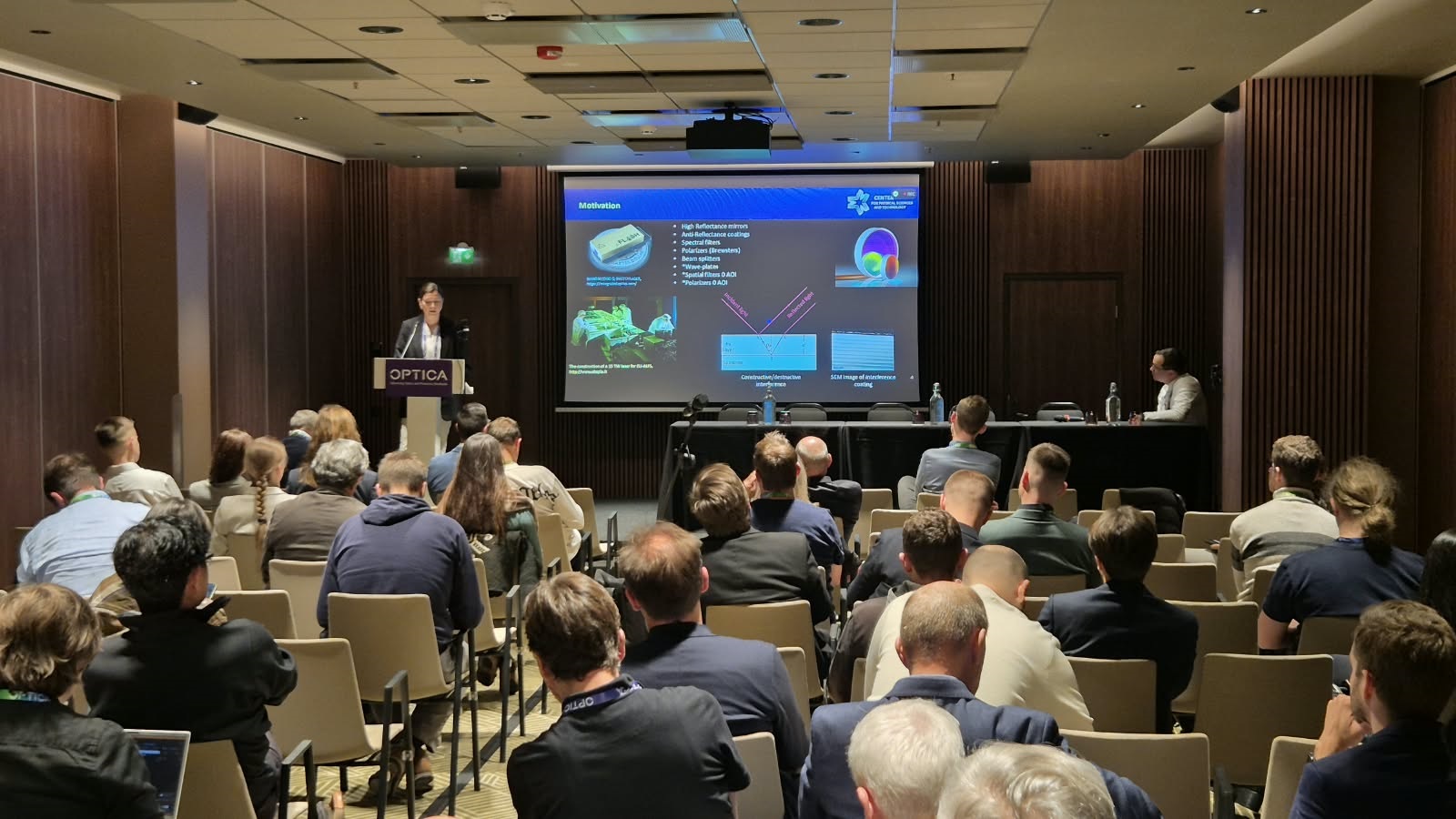
FTMC was represented at the congress by researcher dr. Lina Grinevičiūtė, who presented “Nanostructured Coatings for High-Power Laser Optics: Waveplates, Polarizers and Diffractive Elements.” The presentation was included in the Laser Applications programme, which explored laser-based materials processing, from the treatment of large-scale objects to micro- and nanotechnology.
In high-power laser systems, optical components must withstand intense laser radiation while maintaining their required optical properties. Developing coatings that support reliable component performance and precise control of light is therefore essential.
According to dr. Lina Grinevičiūtė, nanostructured coatings make it possible to control light by modifying the internal nanostructure of a coating. Her presentation discussed glancing-angle deposition, a technique for fabricating nanostructured coatings for waveplates, polarizers operating at normal incidence, and advanced diffractive elements. Such solutions could be relevant to laser manufacturers developing high-power laser systems and microlasers. They may expand the functional capabilities of optical components and enable new approaches to laser system design.
HiLASE: High-Power Lasers and Advanced Micromachining Methods
The HiLASE Centre, coordinator of the LASER-PRO project, specialises in the development and application of high-power diode-pumped solid-state laser systems. Its research activities include laser shock processing, laser micromachining and the assessment of optical components’ resistance to laser radiation.
At the congress, HiLASE researchers presented three research topics covering the development of new laser sources and advanced micromachining methods.
- Thin Ho Thin-Disk Regenerative Amplifier. The presentation outlined preliminary research results for a holmium-doped yttrium aluminium garnet (Ho) thin-disk regenerative amplifier. The system incorporates a custom-designed 60-pass pump head pumped by a high-power thulium-doped fibre laser. The signal is generated by a holmium-doped fibre laser system. Further development of this technology could contribute to advanced laser amplifier systems and support research and applications requiring high-power laser pulses.
- Diode-Pumped Alexandrite Thin-Disk Laser. HiLASE researchers developed a thin-disk pumping chamber for an alexandrite crystal. Under continuous-wave operation, the laser achieved a maximum output power of 9.5 W and an optical efficiency of 21.5%. The results demonstrate the application of thin-disk laser design principles to alexandrite crystals, broadening the possibilities for developing new laser sources for scientific research and specialised photonics systems.
- High-Fidelity Phase Mask Generation via a Refined Gerchberg–Saxton Algorithm for Fourier-Plane Two-Photon Polymerisation. The presentation introduced a refined Gerchberg–Saxton algorithm for generating high-fidelity phase masks. Combined with camera-in-the-loop feedback, the algorithm aims to improve laser beam control and accelerate the fabrication of microstructures using two-photon polymerisation. The method has potential for producing complex three-dimensional microstructures, microscopic optical elements and photonic components.
Together, these studies reflect HiLASE’s research focus, spanning laser source development, precise light control and advanced microfabrication. They highlight opportunities to develop new solutions for photonics and advanced manufacturing.
ELI ERIC: X-Ray Sources, XUV Radiation and Emerging Acceleration Technologies
ELI ERIC is an international research infrastructure that provides scientists with access to ultra-high-intensity laser systems and advanced experimental facilities. Research presented from ELI Beamlines at the congress highlighted the potential of laser-driven radiation sources and plasma-based electron acceleration.
- Laser-Driven X-Ray Sources at ELI Beamlines for Ultrafast Spectroscopy, Diffraction, and Imaging. These sources enable researchers to investigate material structures, structural changes and ultrafast physical processes. The use of ultrashort X-ray pulses makes it possible to observe changes occurring over extremely short timescales and to conduct time-resolved studies of materials.
- The ELI Beamlines HHG Beamline as a Flexible XUV Source and a Platform for High-Harmonic Spectroscopy. The high-harmonic generation (HHG) beamline provides access to extreme ultraviolet (XUV) radiation for advanced experiments and investigations of the high-harmonic generation process itself. This research helps deepen our understanding of light–matter interactions and ultrafast phenomena.
- Laser-Driven Electron Acceleration to 10 GeV in All-Optical Plasma Waveguides. The presentation examined laser wakefield acceleration using plasma waveguides. At Colorado State University, the ALEPH laser was used to demonstrate electron acceleration to approximately 10 GeV. At ELI Beamlines, the L3-HAPLS laser achieved 5 GeV acceleration, alongside demonstrations of high-repetition-rate plasma guiding. These results highlight the potential of plasma-based acceleration for the development of more compact high-energy particle accelerators.
These developments are relevant beyond fundamental physics. Laser-driven X-ray sources can be used to investigate material structures and ultrafast processes, while plasma-based acceleration technologies could contribute to the development of more compact accelerators in the future. Such technologies may also open up new possibilities for radiation source development, materials science experiments and advanced medical imaging and diagnostic technologies. Further research and technological development will be required before the latter applications can be realised.
A Shared Goal: From Research Results to Practical Applications
The work presented by LASER-PRO partners spans key areas of laser technology, from laser sources and optical components to precise radiation control, materials research and advanced manufacturing methods. International events such as Optica Laser Congress provide an opportunity to share these findings with the wider scientific community and establish connections for future collaboration.
“The conference gave us an opportunity to present the results of our ongoing research to an international audience and establish new contacts for future collaboration and joint project development. It was particularly exciting that this international conference, which travels around the world, was held in Vilnius,”- says dr. Lina Grinevičiūtė, a researcher at FTMC.
Optica Laser Congress and Exhibition is an international event on laser science and technology organised by Optica, an organisation serving the optics and photonics community. The event brings together researchers, engineers and industry representatives to share research findings, discuss advances in laser technologies and explore opportunities for collaboration.

Project number: 101186838
Funding: Funded by the European Union.
Views and opinions expressed in this article are however those of the author(s) only and do not necessarily reflect those of the European Union or the European Research Executive Agency (REA). Neither the European Union nor the European Research Executive Agency can be held responsible for them.