- Home
- News & Events
- News

New Food Safety Tool: FTMC Team Aims to Develop a Sensor for Detecting Milk Contaminants
Do we always consume milk that is of high quality and free from contaminants? To help answer this question, a team from the FTMC Department of Nanotechnology is carrying out important research.
In February 2025, FTMC launched a new project under the Lithuania-Poland international cooperation program (DAINA 3) “Analitiniai pieno produktų teršalų nustatymo metodai naudojant elektrocheminę multisensorinę platformą su molekulių įspaudais modifikuotais polimerais” (“Analytical methods for detecting milk product contaminants using an electrochemical multisensory platform modified with molecularly imprinted polymers”).
The project aims to conduct scientific research and develop methods for more reliable detection of unwanted substances in milk. The researchers hope that their work will contribute to the creation of a modern sensor capable of simultaneously identifying several hazardous compounds.
“Concerns about food safety are universal, but even the concept itself – food safety – can be interpreted in different ways,” notes Dr Vilma Ratautaitė, one of the project’s authors and a researcher at FTMC Department of Nanotechnology. “Even among scientists, the focus can differ depending on the field of study – some emphasize microbiological contamination, while others concentrate on chemical impurities in food.”
The team chose to focus on milk, a product enjoyed by many people. According to Dr Ratautaitė, under certain circumstances, milk and dairy products can become contaminated with undesirable substances.
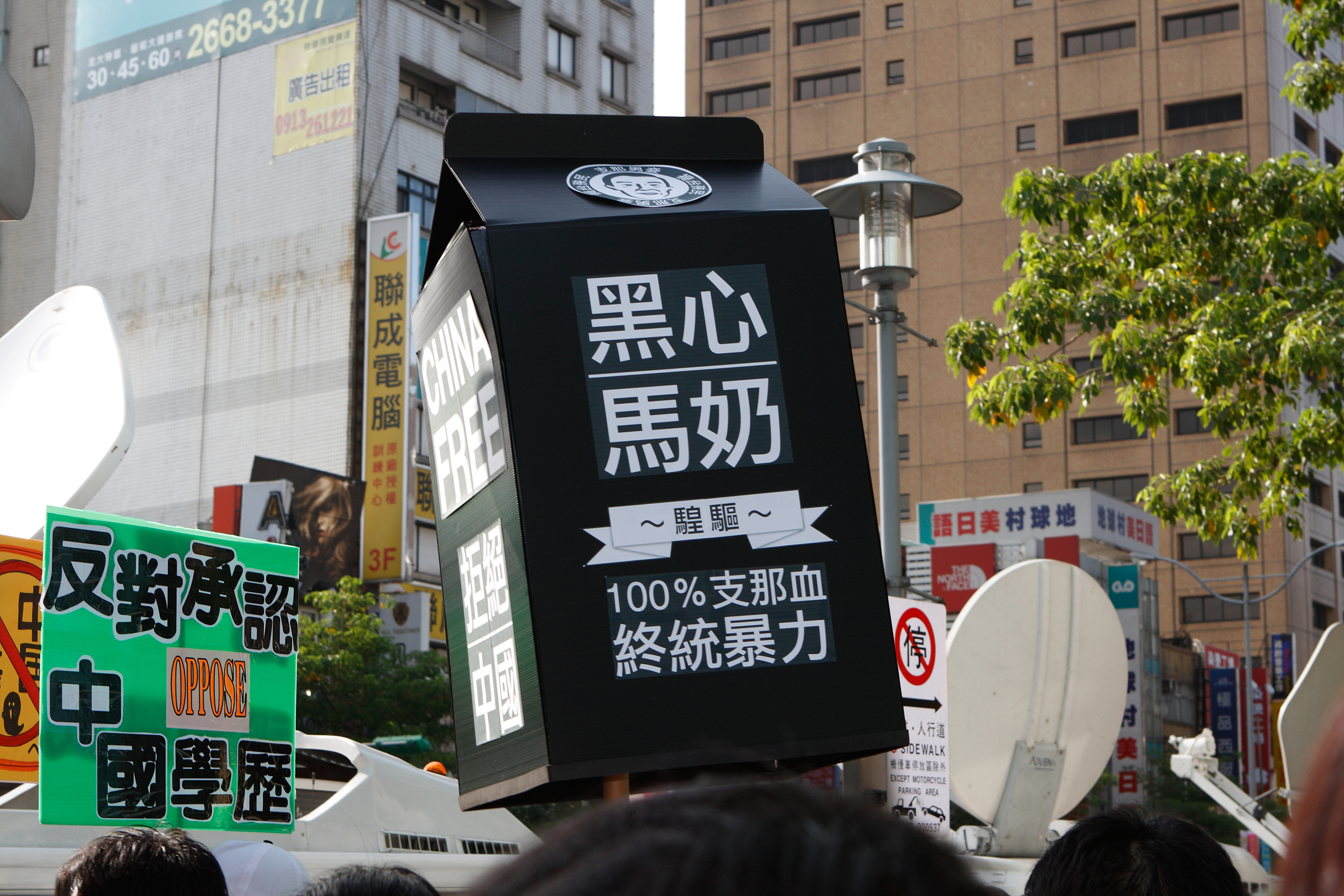
(Half a million Taiwanese citizens protest against Chinese dairy producers, 2008. Photo: MiNe (sfmine79) / Wikipedia.org)
“In the past, international media outlets have reported cases of food fraud and adulteration – such as the 2008 scandal involving milk contaminated with melamine. That incident revealed that even with regular and thorough food quality testing, new and previously unknown methods of contaminating food with harmful or even life-threatening substances can still emerge. This is why scientific research projects focused on developing new analytical tools for detecting unwanted compounds in food are of such great importance to society,” FTMC researchers explain.
The scientists also refer to other studies on this topic. For instance, Nascimento et al. presented valuable insights in their review article on the adulteration of milk’s chemical composition and the methods used to detect it. The authors describe how milk adulteration may be used to disguise poor quality parameters, such as protein or fat content, or to extend shelf life. Reported cases include the addition of substances such as formaldehyde, hydrogen peroxide, hypochlorite, dichromate, salicylic acid, melamine, and urea.
In an experimental study conducted by Ernestas Brazys, a junior research fellow at FTMC Department of Nanotechnology, the potential application of melamine molecule-imprinted polymer (MIP) technology in developing an electrochemical sensor was demonstrated.
.jpg)
(Ernestas Brazys. Photo: Faculty of Chemistry and Geosciences, Vilnius University)
Molecularly imprinted polymers work like locks that recognize only specific keys – particular molecules – and these were used in the development of such polymers. Building on the proven capabilities of this technology, the FTMC team now aims to create a multifunctional device capable of detecting several selected contaminants from different groups of dairy products – such as salicylic acid, antibiotics, antiparasitic agents, or growth-promoting hormones – all at once.
“Undesirable substances in food can pose serious health risks, so it’s crucial to develop selective and sensitive analytical methods that allow for their rapid detection. Electrochemical sensors would be particularly convenient for this purpose – they are inexpensive, compact, and adaptable for analyzing various substances,” explains Dr Ratautaitė.
.png)
(Dr Vilma Ratautaitė. Photo: Hernandez & Sorokina / FTMC)
According to the researcher, both the Polish and Lithuanian partners have significant experience in electrochemistry, MIP synthesis, and related studies. They will collaborate closely to ensure the successful implementation of the project. The results are expected to contribute to environmental and food quality monitoring through the development of new analytical tools based on MIP technology.
Authors: Dr Vilma Ratautaitė, Ernestas Brazys, and Prof Habil. Dr Arūnas Ramanavičius