- Home
- News & Events
- News
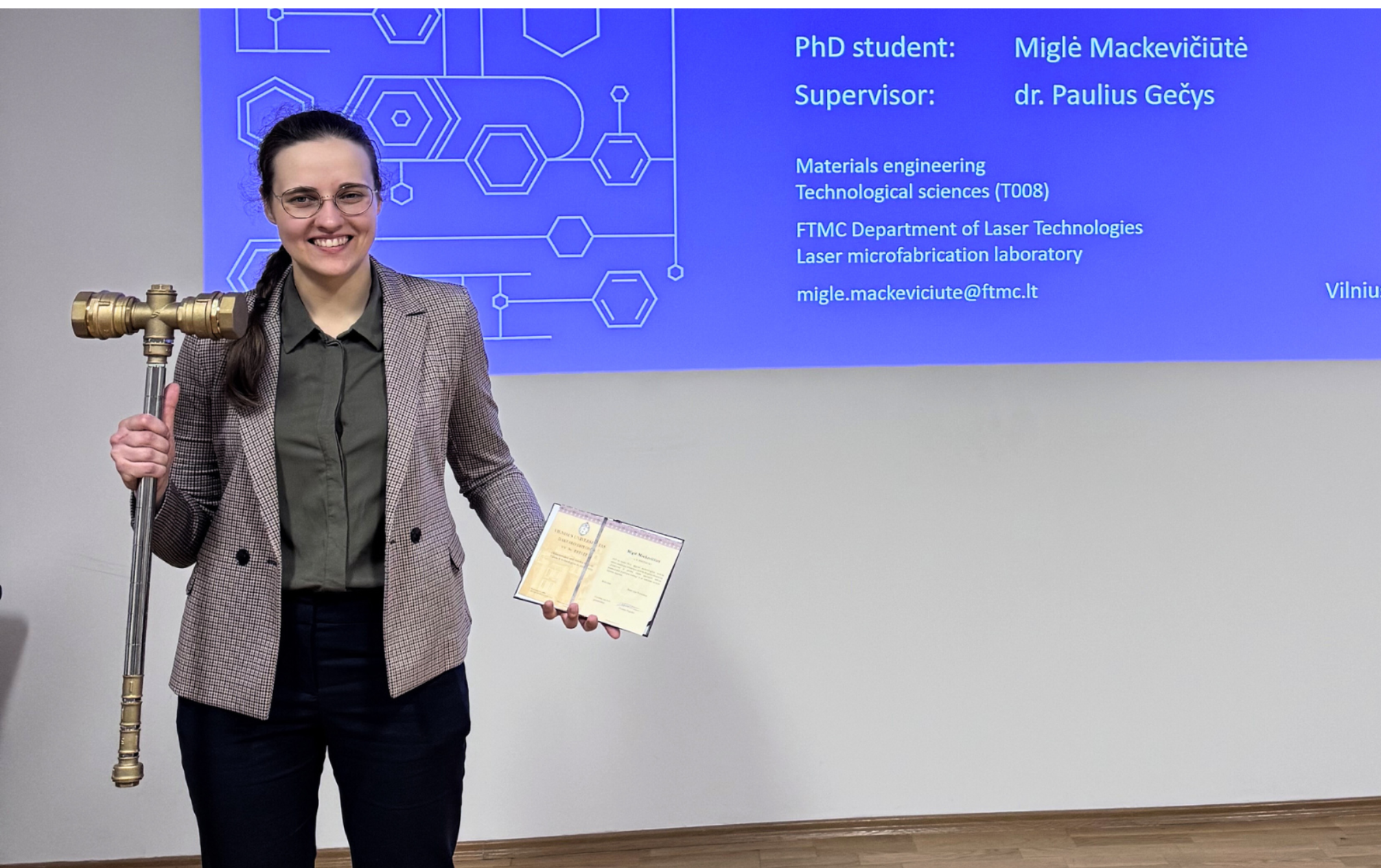
New Laser Technique for Glass Cutting: Miglė Mackevičiūtė Earns a PhD
The FTMC Department of Laser Technologies has a new Doctor of Technological Sciences! On 24 October, Miglė Mackevičiūtė successfully defended her dissertation “Efficient and Fast Glass Cutting Using Laser Bursts” (academic supervisor: Dr Paulius Gečys).
We warmly congratulate our colleague and wish her continued success in her scientific career!
Glass cutting is a highly relevant topic in industry. Glass is used across a wide range of fields, but before it can be applied, it must be properly processed. This is not a simple task – due to the brittle nature of glass, cutting it poses considerable technological challenges.
As Miglė notes in the introduction to her dissertation, the most common method of glass cutting is mechanical scribing and separation, known for its simplicity, speed, and low cost. However, this process produces significant surface chipping. Moreover, the technique can only be applied to cutting simple shapes.
For more complex contours, wire or waterjet cutting may be used. Yet, these alternative mechanical methods are much slower compared with scribing.
Thus, lasers offer the best solution. This technology enables the highest precision, quality, flexibility in complex trajectories, and processing speed. The FTMC physicist applied laser bursts – extremely short laser pulses emitted not individually but in groups or series. In other words, instead of a single powerful laser flash, several ultrashort “shots” are directed at one point in rapid succession, separated by only a few nanoseconds or even picoseconds.

(The glass in your smartphone screen, as well as other components, are also cut using lasers. Photo: Canva.com)
“The dissertation investigated the effect of laser bursts on glass cutting from the bottom side, the formation of volumetric modifications through light filaments, and their application in glass scribing. Laser burst mode is a relatively new operational regime that has recently become highly relevant in microprocessing research and applications. Seeing its potential, we decided to apply it to glass processing, an area where little information existed about its benefits,” explains Dr Mackevičiūtė.
The researcher successfully demonstrated efficient and fast glass cutting using laser bursts, including the cutting of complex contours and thicker glass samples.
“Glass is extremely versatile and widely used in everyday life – from windows and displays to medical devices and solar cells. The ability to cut this material quickly, and to shape complex or thick glass, provides flexibility in manufacturing and speeds up new product development. This, in turn, enables more efficient production of various products that ultimately become more accessible and convenient for everyone,” adds the physicist.
“It was rewarding to see that the same processing system could be used for different types of glass treatment simply by adjusting laser parameters. Using the same laser, we managed to form polarization-controlled modifications that allow glass to be scribed at m/s speeds.
Cutting from the bottom side enabled us to produce complex shapes and cut through thick glass, while dynamically adjusting parameters allowed both fast and high-quality processing modes. This demonstrates the remarkable flexibility of lasers with ultrashort-pulse GHz bursts in glass processing. It is gratifying that these regimes could also be applied in practice for other tasks,” says the PhD.
You can read the full dissertation via this link.
Info: FTMC