- Home
- News & Events
- News
27 June, 2025
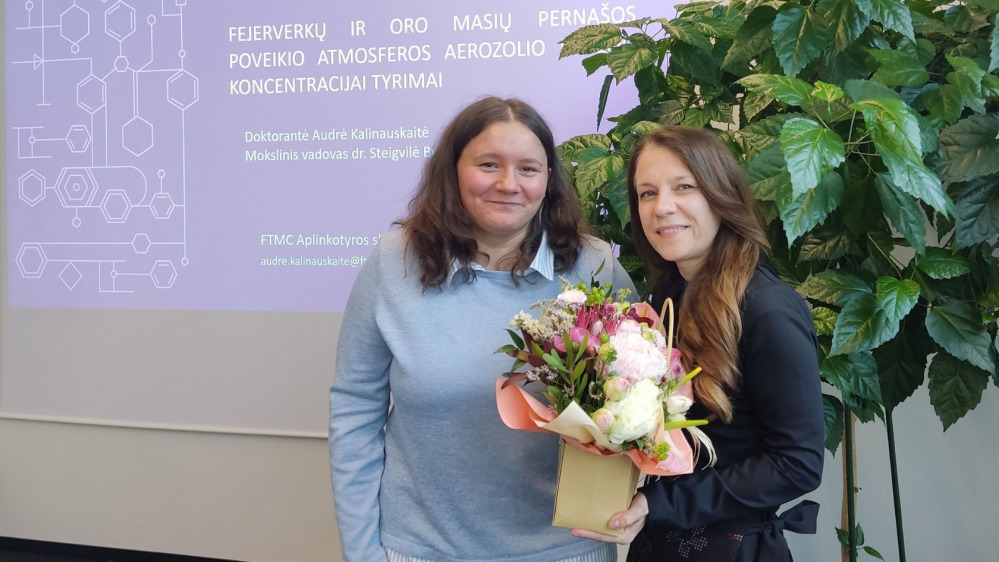
New PhD in Natural Sciences: A. Kalinauskaitė, Researcher of Pollution from Fireworks and Air Masses
The FTMC Department of Environmental Research has a new PhD in Natural Sciences. On 26 June, chemist Audrė Kalinauskaitė defended her dissertation "Investigation of the Influence of Fireworks and Air Mass Transport on Atmospheric Aerosol Mass Concentration" (Academic supervisor: Dr Steigvilė Byčenkienė).
We congratulate our colleague on completing such significant and engaging work!
The dissertation consists of two main parts: it investigates how the concentration of particulate matter - harmful to both health and the climate - is influenced by fireworks and long-range air mass transport.
"Fireworks are a significant short-term source of air pollution, releasing large amounts of fine aerosol particles, heavy metals, and gaseous pollutants. These contaminants not only directly impact air quality but can also participate in complex atmospheric chemical processes that lead to environmental changes. Therefore, assessing pollution from fireworks is important for better understanding the dynamics of air pollutants under various meteorological conditions, their impact on human health, and long-term climate change processes," says Kalinauskaitė.
Meanwhile, air masses are large streams of air that move through the atmosphere over hundreds or even thousands of kilometers, transporting airborne pollutants - such as dust, particulates, and gases - from one region to another. According to the chemist, this is an ongoing atmospheric process that determines the movement of both natural and human-made (anthropogenic) pollutants.

(Dr Audrė Kalinauskaitė. FTMC photo)
"Recent scientific studies have revealed that approximately 12% of early deaths worldwide linked to fine aerosol particles were caused by non-local air pollutants. Regional air pollution by aerosols can be influenced both by locally emitted pollutants and long-range air mass transport.
Research findings show that in Europe, long-range transport of air masses is a significant factor in air pollution. Pollutants emitted into the atmosphere can remain suspended in the air and circulate around the globe for several days or even weeks, depending on weather conditions. These pollutants often reach regions located thousands of kilometers from their original emission sources. For this reason, studying long-range air mass transport is essential for assessing its impact on local and regional air quality," Kalinauskaitė explains.
The scientist identified that the highest concentrations of air pollutants - black carbon (soot), organic aerosol particles, sulfates, chlorides, nitrates, ammonium, and fine particulate matter - were recorded on New Year's Eve. Pollution levels increased several times, in some cases even dozens of times, likely due to the use of fireworks.
"In addition, the contribution of long-range air mass transport to the mass concentrations of aerosol components of different origins was assessed, as well as the ratio of stable carbon isotopes ¹³C and ¹²C in three distinct environments in the Baltic region: urban background, rural, and coastal, " adds Kalinauskaitė.
The author of the dissertation says her work will be valuable in developing advanced technologies and forecasting methods in environmental science:
"New data on the impact of New Year's fireworks and long-range air mass transport on the concentrations, chemical composition, and stable carbon isotope ratios of various aerosol particle components will help refine modeling algorithms. They will also be useful in creating and applying advanced machine learning models for more accurate predictions of aerosol particle dynamics and source attribution in different environments.
What excites me most about this dissertation is the revealed impact of New Year's fireworks, meteorological conditions, and long-range air mass transport on atmospheric pollutant mass concentrations across different Lithuanian environments - urban background, rural, and coastal. It clearly shows how strongly these distinct (short-term and long-term) pollution factors affect air quality in various settings."
Info: FTMC