- Home
- News & Events
- News
Newly Awarded PhD – Jaroslav Kodz, the First in the World to Demonstrate a New Type of Laser Component
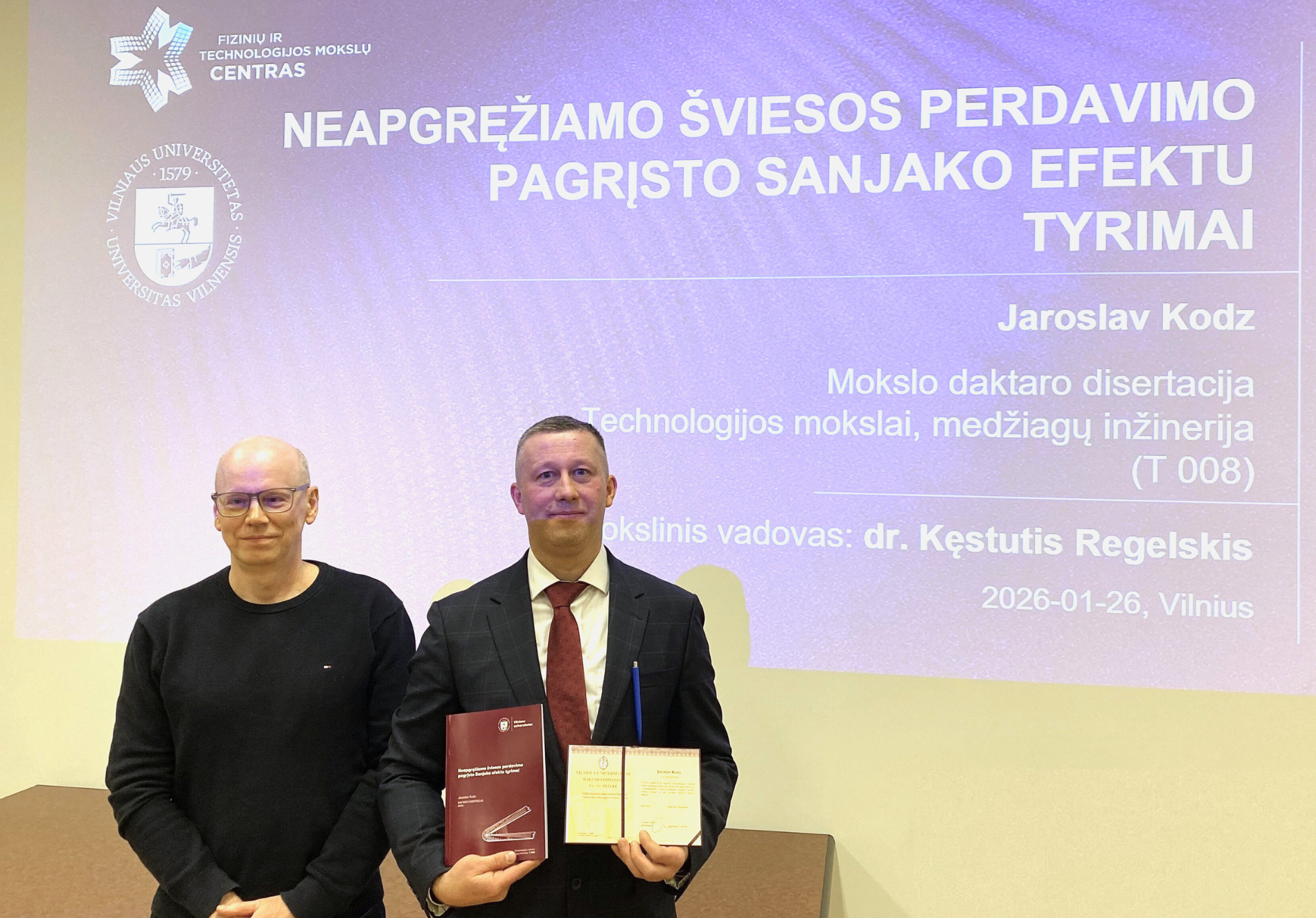
On 26 January, physicist Dr Jaroslav Kodz from the FTMC Department of Laser Technologies successfully defended his doctoral dissertation. The title of his thesis is “Research on Non-Reciprocal Light Transmission Based on the Sagnac Effect” (academic supervisor: Dr Kęstutis Regelskis).
For the first time in history, the dissertation describes and successfully demonstrates a new type of optical isolator whose operation is based on the Sagnac effect.
In brief, an optical isolator is a key component in laser systems that allows light to propagate in only one direction, thereby protecting the laser from unwanted back reflections. The Sagnac effect, meanwhile, is a phenomenon in which light (in this case, a laser beam) travelling around a closed loop in opposite directions within a rotating system takes different amounts of time to complete the same path.
“The concept of such a device was conceived and demonstrated for the first time globally at the FTMC Department of Laser Technologies, in the Fiber Lasers Laboratory. The author of the idea and my supervisor is Dr Kęstutis Regelskis. I transformed this idea into a fully functioning device and carried out an in-depth investigation of its properties. The essence of the dissertation is the development and characterisation of an optically isolating device that operates on a fundamentally different principle,” says Dr Kodz.
The scientist explains that the most widely used optical isolator technology today is based on so-called Faraday isolators. However, this approach faces several challenges:
“There is a limited number of magneto-optical materials suitable for constructing such isolators – particularly in the ultraviolet and mid-infrared spectral ranges. Moreover, all of these materials rely on rare-earth elements, which have recently become associated with significant geopolitical tensions worldwide. Optical isolators based on the Sagnac effect represent a potential alternative that does not require specific, hard-to-obtain materials and, in certain cases, could replace Faraday isolators,” explains Jaroslav.
Thus, the FTMC physicist has, for the first time in history, demonstrated a fully functional optical isolator based on the Sagnac effect.
“We also managed to demonstrate its operation not only with narrowband radiation, but even with light having a spectral bandwidth of approximately 50 nanometres (FWHM). In both cases, the achieved optical isolation was comparable to that of commercial Faraday isolators, i.e. around 20 dB or higher, which demonstrates the potential for practical application of such devices,” says the newly awarded PhD.
Congratulations to our colleague, wishing him continued success in pursuing impactful research!
The doctoral dissertation (in Lithuanian, with English summary) can be accessed by following this link.
Info: FTMC