- Home
- News & Events
- News

One of the Most Renowned Lithuanian Scientists Dr Darius Čeburnis: Understanding Clouds Is Critically Important
From 8–10 October in Vilnius, the EcoBalt 2025 conference hosted a special guest and one of the most prominent Lithuanian scientists of all time – Dr Darius Čeburnis, who ranks among the top 1% of the most cited authors in the field of geosciences worldwide.
After defending his PhD at the former Institute of Physics in Lithuania (now Center for Physical Sciences and Technology, FTMC), Dr Čeburnis has, since 2001, been working at the prestigious University of Galway in Ireland.
His most significant work is related to marine aerosols – tiny particles that rise from the ocean surface into the air. These particles help clouds to form and influence the climate. His research in this field has been recognized by three publications in the world’s leading scientific journal Nature (in 2004, 2016, and 2017).
Recently, his research focus shifted toward polar regions under collaboration with the Korean Polar Research Institute with two accomplished summer campaigns in Antarctica and the upcoming one to the Arctic Ocean on the icebreaker ARAON.
At 57, Dr Čeburnis has also significantly contributed in developing Ireland’s Mace Head Atmospheric Research Station, helping it become the top atmospheric research infrastructure in the world.
We spoke with Dr Darius Čeburnis about his joy in contributing to Lithuania, the critical importance of cloud research, and his concerns over humanity’s indifference to scientists’ warnings.
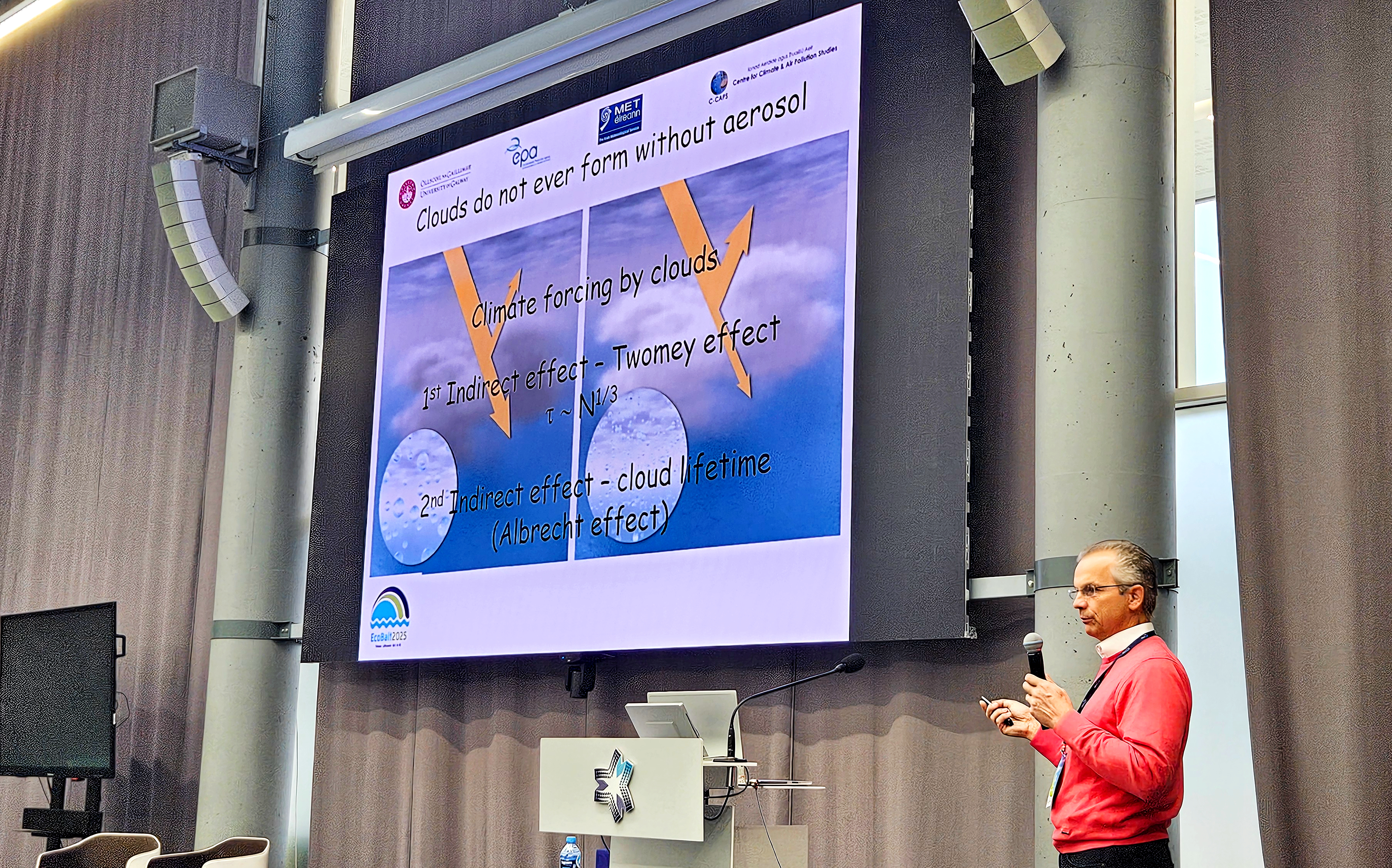
(Dr. Darius Čeburnis' talk. Photo: FTMC)
If I’m not mistaken, you’re among the Lithuanian scientists with the most publications in Nature – perhaps even at the top of the list. Have you ever checked that? Counted your fellow Lithuanians’ papers?
At first, yes – I was curious. But when the number of publications began to grow, I lost track. It also depends on how we define a “Lithuanian”. There are quite a few scientists of Lithuanian origin working abroad who no longer show their Lithuanian affiliation, which makes it difficult to know the real numbers.
Back in 2004, when my first Nature paper came out, there were just a handful of Lithuanians publishing there – it was easy to keep count. Now it’s more complicated. I’m a co-author of three Nature papers – a nice number, though probably not the highest among Lithuanians.
There are others who are extremely productive – for example, the laser scientist Andrius Baltuška, who works in Austria and has published many papers in Nature and Science.
Do you see your publications as a way of promoting Lithuania? Is that important to you?
Absolutely. When we published the first Nature paper, I was already working abroad, but I made sure that my Lithuanian affiliation appeared in the paper, even if it wasn’t strictly accurate (smiles). It was important for me that there was a visible Lithuanian trace.
So you were listed as affiliated both with the National University of Ireland in Galway and with the Institute of Physics in Lithuania?
Yes. I was already working in Ireland, but I wanted the words “Institute of Physics, Lithuania” to appear.
A patriotic touch, then.
Absolutely. That’s why I always accept invitations to take part in Lithuanian scientific projects and initiatives. At first, it felt like giving something back – if you’ve left and you’re doing well abroad, you should also contribute to your home country, even indirectly.
Now I wouldn’t even call it “giving back” – I’m just genuinely interested in helping people learn something useful. I suppose I’m naturally patriotic – that’s part of my family story.
There have always been many patriots in my family. My grandfather’s brother was a volunteer soldier in the first Lithuanian army in 1919. My father was a volunteer in the National Defence Volunteer Forces in the 1990s. I didn’t join the army myself, but I try to contribute to Lithuania in other ways – not necessarily by promoting it, but by helping where I can.

(Illustrations from the book Savanoris 1918–1920. Lietuvos kariuomenės kūrėjų savanorių knyga (Volunteer 1918–1920: Lithuanian Army Founding Volunteers), 1929, pp. 25, 26, and 27. Available online: https://kam.lt/wp-content/uploads/2022/03/savanoris-1918-1920.pdf. Background: photo from Canva.com)
Speaking of your former workplace – the Institute of Physics, now FTMC – and the environmental research carried out there, what impression do you have of Lithuanian science?
The level is good – solid in a global context. But there are still untapped opportunities. Nowadays, everyone understands that science progresses through collaboration. The most remarkable discoveries happen through partnerships.
For example, my work in the Antarctic and Arctic came about only because of cooperation with the Korea Polar Research Institute: they had perfect infrastructure, we had deep knowledge – together it worked beautifully.
And we must also acknowledge the importance of English. It’s been said many times, but it’s crucial – scientists need to treat English as their second native language. There’s no other way. To share knowledge properly, one must communicate clearly. Without strong English, you lose nuances and cannot discuss ideas fully.
The younger generation is improving fast, though, so this problem may soon disappear naturally. But yes – it used to be quite visible and limited collaboration.
.jpg)
(Photo: Canva.com)
Let’s talk about your scientific work – your first Nature paper in 2004 marked a turning point. You and your colleagues showed that marine aerosol particles arise not only from sea salt but also from organic material, from marine life itself?
That’s right – from salt and from life. It used to be thought that it was just salt, and that was it.
And you also showed that these organic compounds strongly promote cloud formation. What does this mean for our understanding of climate?
Understanding clouds is absolutely essential. They are immensely varied. While we understand how an individual cloud develops, we still don’t fully grasp the global picture.
Our findings about organic compounds, published back in 2004, are still relatively new and not yet integrated into global models. Scientists are now testing where and when our models hold up and where they fail. Eventually, this will allow us to scale the knowledge globally.
Clouds are cirital to the climate system. Being white, they reflect sunlight, but without understanding aerosols, we have no chance of understanding clouds.
What are the key questions you’re tackling now?
It’s hard to say what lies ahead. Instruments are constantly improving – sometimes you don’t even know what new insights they’ll bring. The main thing is to make good, precise measurements.
A big challenge is the cost – it’s incredibly expensive to study clouds directly. Aircraft flights cost over €100,000 per day.
Does the aircraft fly into the cloud and take measurements?
It flies at various altitudes, measuring everything that’s needed. But one day in the clouds tells you very little about seasonal variation – how things change throughout the year. You fly here, you fly there… Of course, it has to be done – the results are more accurate when compared with ground-based measurements or remote sensing. All of this is necessary. But as I said, these flights are always short – because of the high cost.
And another thing: how much can you actually fly? We only get results from the hours when the plane is actually airborne. When it’s not flying – nothing. For example, the aircraft doesn’t operate at night – eight hours immediately vanish. And yet, nature evolves 24 hours a day, on its own schedule, not according to when we want it to.
At the conference, someone asked whether drones could replace aircraft.
Yes, drones are increasingly used. They’re getting more capable, and instruments smaller. They can’t fully replace aircraft, but miniaturised technology may soon let us do similar work much more cheaply.
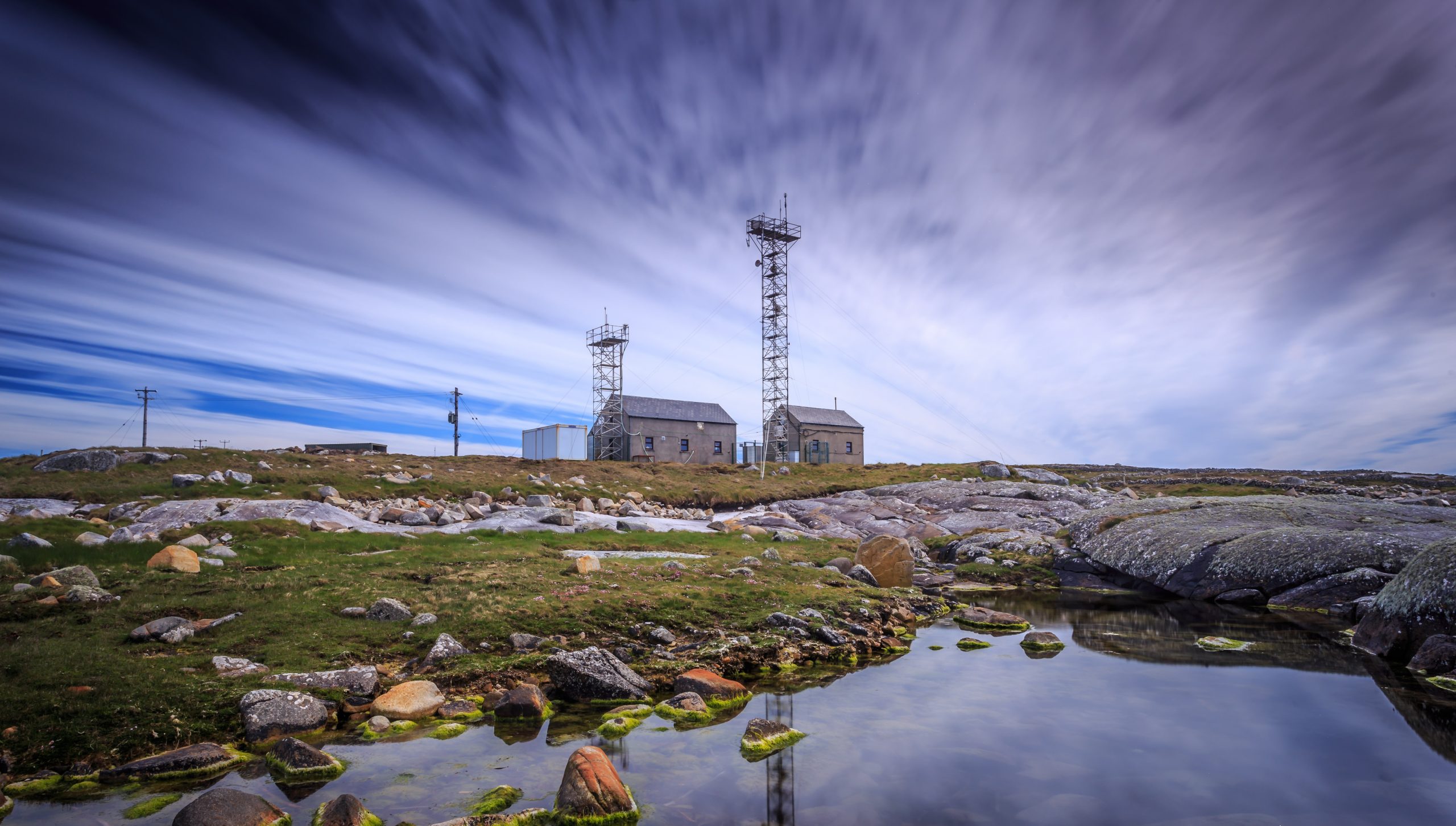
(Mace Head Atmospheric Research Station. Photo: Macehead.org)
In your talk, you also mentioned the Mace Head Atmospheric Research Station on Ireland’s west coast. What makes it special worldwide?
Two things. First – its location. The station is perfectly placed to receive clean air masses from the Atlantic Ocean.
Polluted air masses are everywhere. You measure here, you measure there – on any continent, in any location. On land, it’s relatively easy to take measurements, but over the ocean it’s almost impossible – you need a ship or some other platform.
Our station is unique because it captures this clean ocean air without actually being at sea – it’s like measuring from a ship while standing on solid ground. That location was, in a sense, a lucky accident, but a brilliant one.
Someone once decided that the station should be located right here, and it turned out to be a perfect decision. Looking back now, it’s hard to imagine a better choice. There were even thoughts about relocating the station – after all, it’s ageing, and the infrastructure is deteriorating. We thought we might find a better site. But there isn’t one. We scoured the entire Irish coastline – geographically, climatically, in every respect – and simply, there’s no better place. It needs to remain where it is.
That’s one thing. The second is the timescale, long-term data record. Comprehensive measurements have been ongoing for over 35 years, since 1990. We monitor greenhouse gases, freons that destroy the ozone layer, and many other parameters. The longer the record, the greater the scientific value, because the data gain historical continuity. You can build a new station easily, but without context you’ll never know how things have changed over time. Nature operates at its own pace – we must work at nature’s speed, not ours.
Looking at decades of data, how worried are you about our future and climate change?
We’re going downhill (smiles sadly). As I like to say, trembling boldly, we move forward – and doing very little. Because everything unfolds in real time, people aren’t alarmed. What happens in ten years hardly bothers anyone; what happens in fifty or a hundred – even less. “Not my problem,” they think. That attitude – ‘after me, the flood’ – is, unfortunately, very common.
But we should do the right thing not because it benefits us, but because it is the right thing. That’s common sense – but common sense is becoming scarce. It’s easier to burn fuel than to develop renewables. Lobbyists reinforce this attitude, saying we don’t need renewable energy – just keep burning. There are various ‘actors’ who attempt to turn a blind eye to the situation.
And the situation is getting worse, and fast. Atmospheric processes aren’t linear. We’re still at the lower bend of the exponential curve – the true “beauty” of climate change hasn’t yet shown itself. It’s already inevitable, just not yet realised.
The climate extremes we see now – for example, Lithuania having no summer this year – are just the first signs. Once we reach the non-linear phase, we’ll see what’s really happening.
So, we should prepare – and listen to scientists?
Yes, but no one listens. Perhaps it’s because respect for intellect has faded. Everyone thinks artificial intelligence will do the work for us – nonsense. AI will solve nothing, because there is, in reality, only one kind of intelligence. There is no such thing as “artificial” intelligence – only algorithms.
I’m honestly appalled by how AI is being marketed. Yes, algorithms exist, and they can be useful – but let’s call things what they are, rather than creating illusions that they’ll fix our problems. They won’t. At least not in the next fifty years.
Interview by Simonas Bendžius