- Home
- News & Events
- News
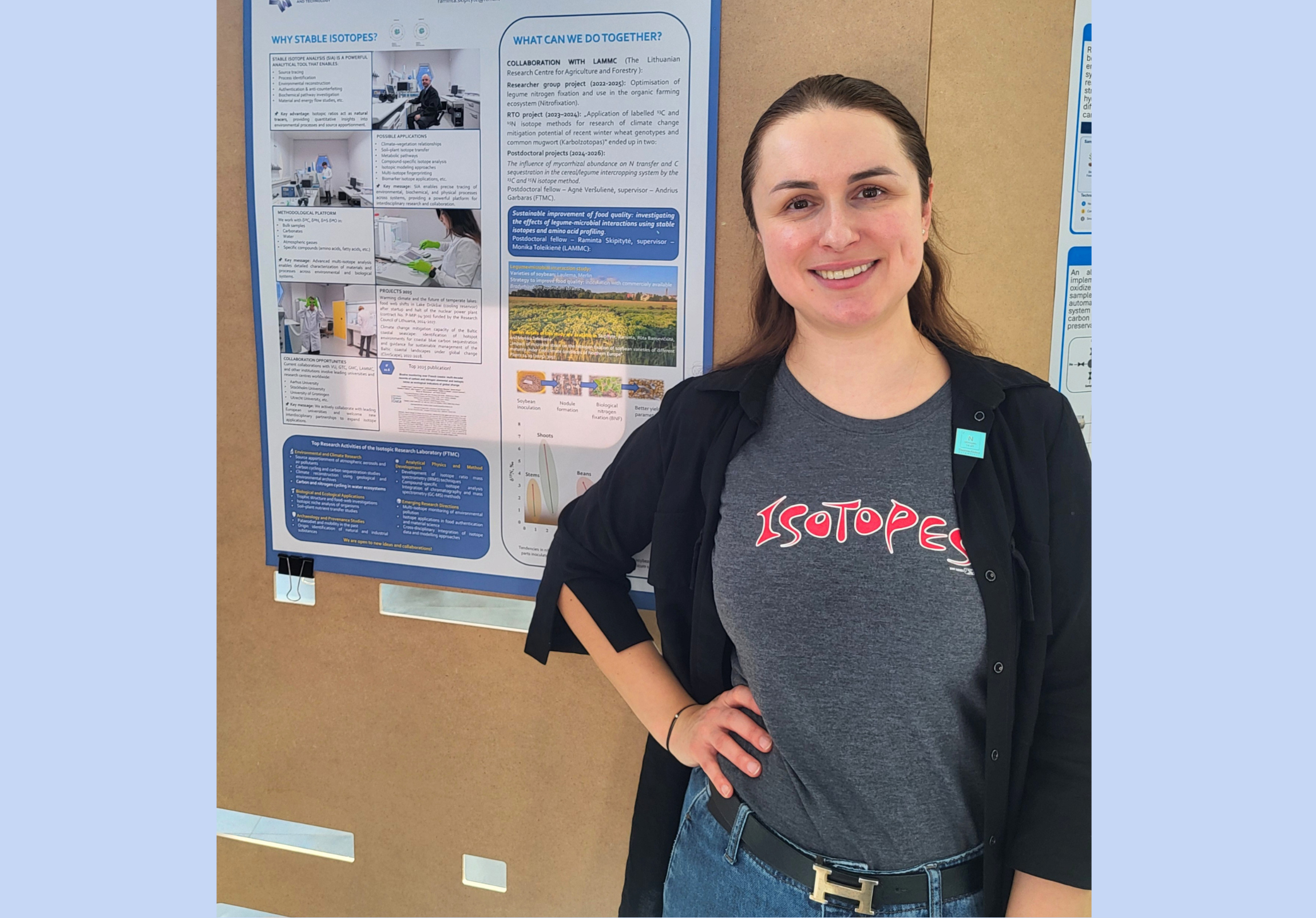
Dr Raminta Skipitytė, Working on More Sustainable Food, Wins Award at the International Conference
Dr Raminta Skipitytė, a scientist from the FTMC Department of Nuclear Research, has won the Best Oral Presentation Award at the international scientific conference ISO-FOOD 2026, held in Italy.
ISO-FOOD is one of the most important international symposium dedicated to research on food authenticity and traceability, that is, the ability to track and verify where food comes from and the path it takes from production to the consumer. The event addresses global challenges related to food safety, quality, and sustainability.
During one of the conference sessions, Dr Skipitytė presented her research entitled “Sustainable improvement of food: investigating the effects of soybean-microbial interactions using stable N and C isotopes”.
According to the researcher, within the framework of the European Green Deal, increasing attention is being paid to protein crops and local protein production to reduce dependence on imported raw materials. As a result, legumes, including soybeans, are gaining growing importance.
The research presented by Dr Skipitytė forms part of her postdoctoral fellowship, during which she analysed how soybean plants respond to different management practices, with particular emphasis on the use of beneficial bacteria (inoculation). These bacteria help plants assimilate nitrogen from the atmosphere, thereby improving nutrient supply under cooler climatic conditions.
“In this study, I aimed to assess the compatibility between soybean plants and different strains of the bacterium Bradyrhizobium japonicum. I analysed nitrogen and carbon dynamics within the plants and determined how the applied treatments affect protein accumulation in different plant tissues. This knowledge provides a scientific basis for further recommendations on crop cultivation technologies.
The topic attracted considerable attention at the conference, with several related presentations, highlighting its relevance within the scientific community. I believe my presentation stood out not only because of the research focus, but also because it was updated in line with the latest recommendations of the International Atomic Energy Agency (IEAE) and recent updates to delta notation, a method used to express how much a sample differs from a standard value. I also improved the presentation’s graphical elements, which were noted by the judging panel,” says the researcher.
.jpg)
(Soybean. Photo: Canva.com)
She explains that the conference title itself reflects the main thematic focus, namely the application of isotopes (atoms of the same element with similar properties) in food research. Isotopic methods are used to analyse food origin and authenticity, identify the sources of ingredients, and assess agricultural practices, such as organic versus conventional farming.
In a broader context, the symposium addressed issues including food authenticity and traceability, food metrology, food science (foodomics), new food sources, sustainability, risk assessment, and effects of climate change on food systems.
“As this was not my first time attending the ISO-FOOD, it was particularly interesting to evaluate the latest trends. The field is developing rapidly, with new methodologies and their synergies being explored, and with modelling, machine learning, blockchain technologies, and other tools increasingly being applied.
There is also a growing need to establish not only individual laboratories, but international comparative databases. This requires high measurement accuracy, result comparability between laboratories, standardised methods, and inter-laboratory comparisons, areas in which organisations such as the IAEA are ready to take a coordinating role.
In the future, individual studies are likely to be increasingly integrated into larger international projects, with stronger collaboration between research institutions and the development of comprehensive databases. At the same time, new challenges will emerge, as issues related to food authenticity and traceability continue to evolve and remain highly relevant,” notes Dr Skipitytė.
We congratulate our colleague on this international recognition and wish her continued success in her meaningful work!
Source: FTMC