- Home
- News & Events
- News
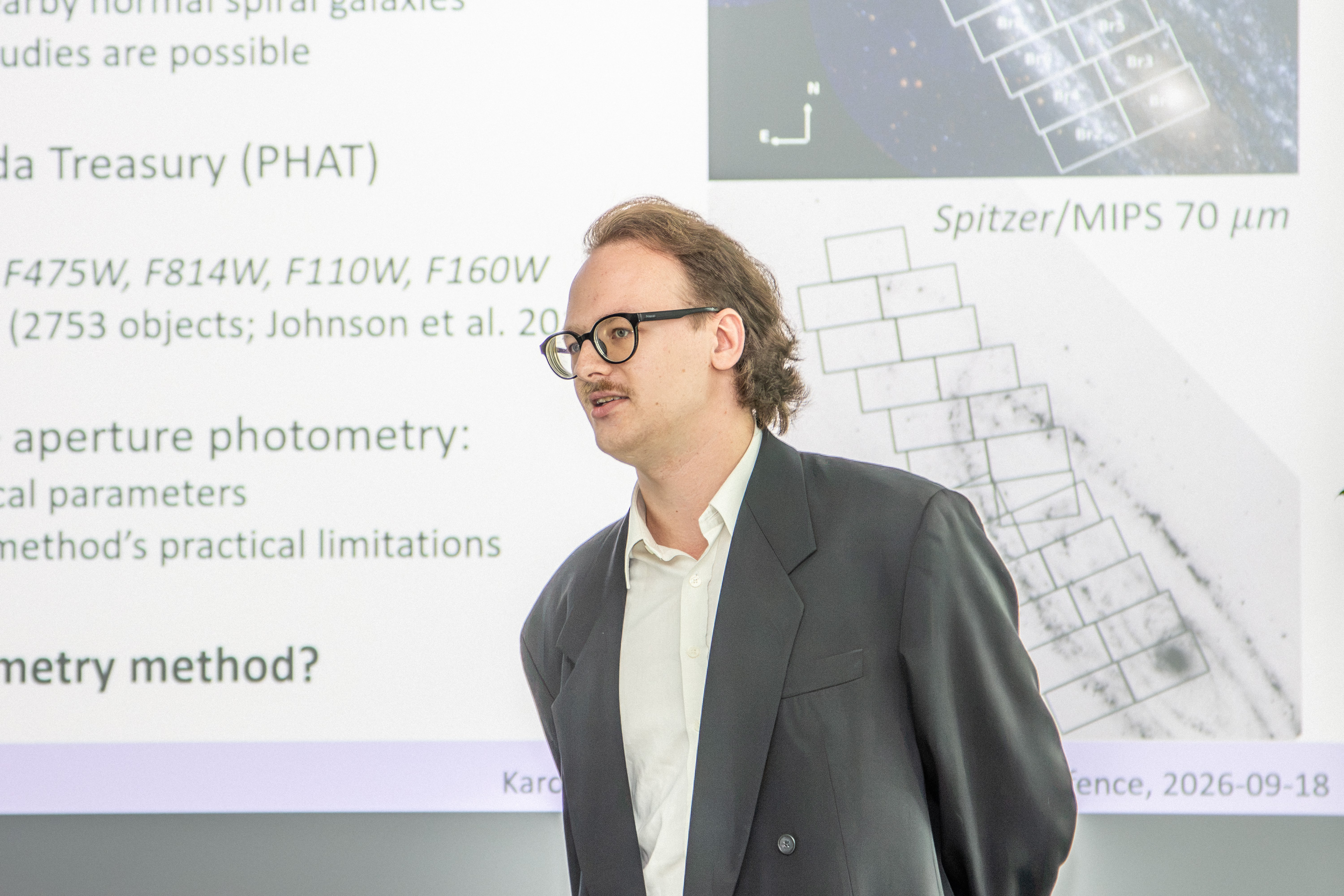
Researching the Evolution of Star Clusters: FTMC Astrophysicist Karolis Daugevičius Earns a PhD in Natural Sciences
Karolis Daugevičius, an astrophysicist at FTMC Department of Fundamental Research, has been awarded a PhD in Natural Sciences. He successfully defended his doctoral thesis, "Star Clusters in Galactic Discs. Limits of Aperture Photometry Applications" (supervisor: Dr Rima Stonkutė).
The research focuses on star clusters, systems of stars born together, and on how reliably their properties can be determined in other galaxies.
"Star clusters are, in a way, witnesses to the history of galaxies. By studying their age, mass, chemical composition and structure, we can infer when and how stars formed within a galaxy," explains Dr Daugevičius.
A significant part of the dissertation is devoted to one of the most widely used methods in star cluster studies: aperture photometry, which measures the amount of light received from an astronomical object in a digital image. In his work, Karolis sought to determine the limits of this method's accuracy.
Another part of the research examined star clusters at the very edge of these methodological capabilities in our neighbouring Andromeda Galaxy, located approximately 2.5 million light-years away. Here, Karolis focused primarily on the evolution of star cluster sizes, investigating how clusters expand over time because of various internal and external influences.
"As is often the case with fundamental research, it can be difficult to identify an immediate and direct benefit to everyday life. What is important, however, is that we contribute to a better understanding of the Universe around us. In my case, this means a deeper understanding of star clusters and galaxies similar to our own Milky Way.
Another important aspect of this type of research is that we work at the limits of current methodological and technological capabilities. My studies were no exception. On numerous occasions, I had to find ways of adapting or improving analytical and modelling methods in order to achieve meaningful results. It is worth noting that this is often how fundamental science ultimately affects everyday life: methods and algorithms originally developed for basic research later find applications in areas such as finance, medicine and even the technologies behind smartphone cameras," emphasises the FTMC researcher.
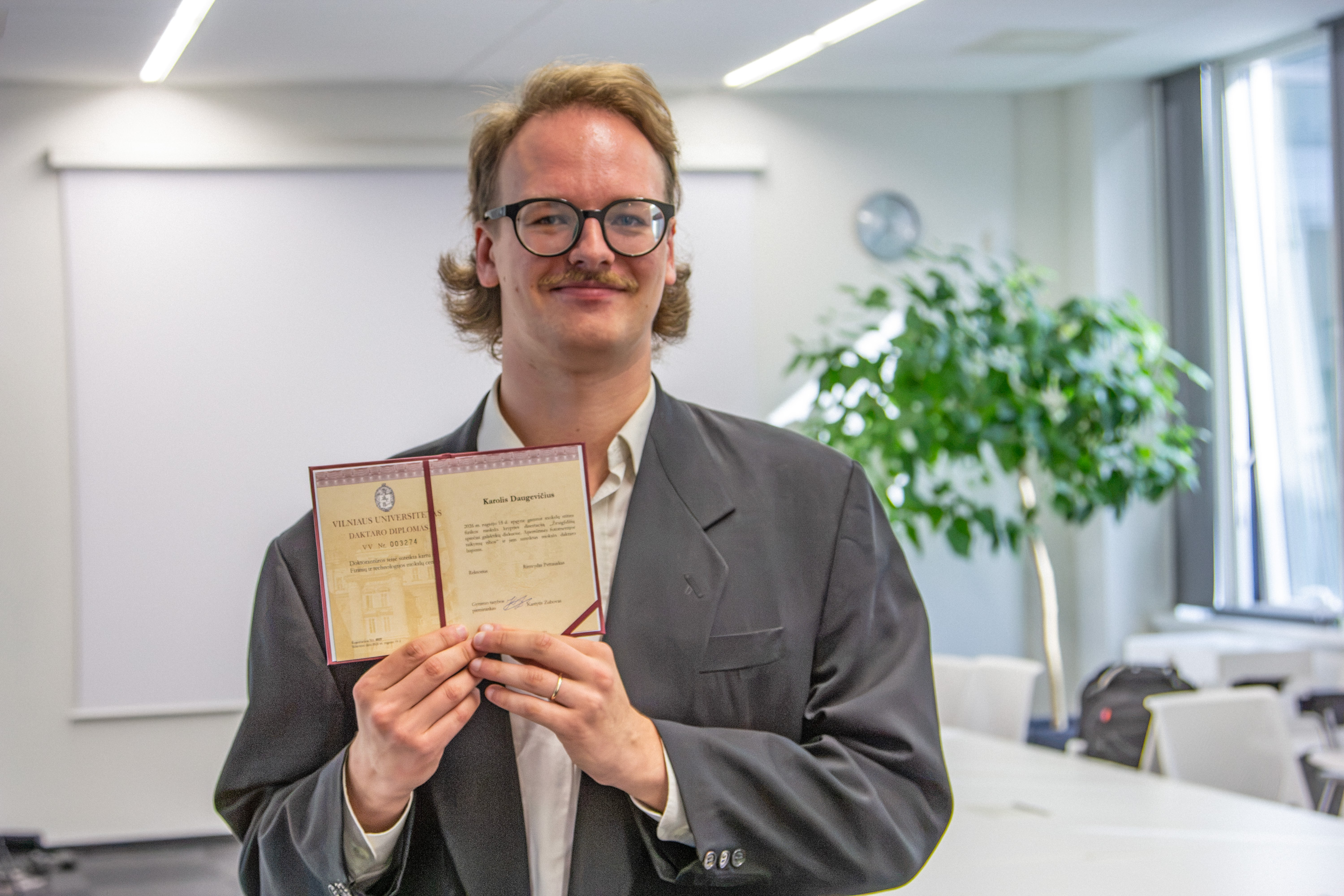
(Dr Karolis Daugevičius. Photo: FTMC)
According to Karolis, one of the most important achievements of his work was a successful and comprehensive determination of the accuracy limits of aperture photometry. He hopes that the findings will help future researchers interpret observational data more reliably and draw sound scientific conclusions.
"I am also pleased with the results of the study on the evolution of star clusters in the Andromeda Galaxy. We found that these clusters undergo very rapid expansion during the first 30 million years after their formation. In astronomical terms, this is a relatively short period of time. The expansion is driven by fascinating internal processes, including stellar winds, explosions and related phenomena.
Interestingly, similar results have been obtained for star clusters in our own galaxy, the Milky Way, suggesting that this may be a typical evolutionary pathway for star clusters.
It is rewarding to know that my research contributes to a broader understanding of how star clusters, and galaxies in general, form and evolve," says the newly awarded Doctor of Natural Sciences.
His dissertation can be accessed via this link.
Source: FTMC