- Home
- News & Events
- News
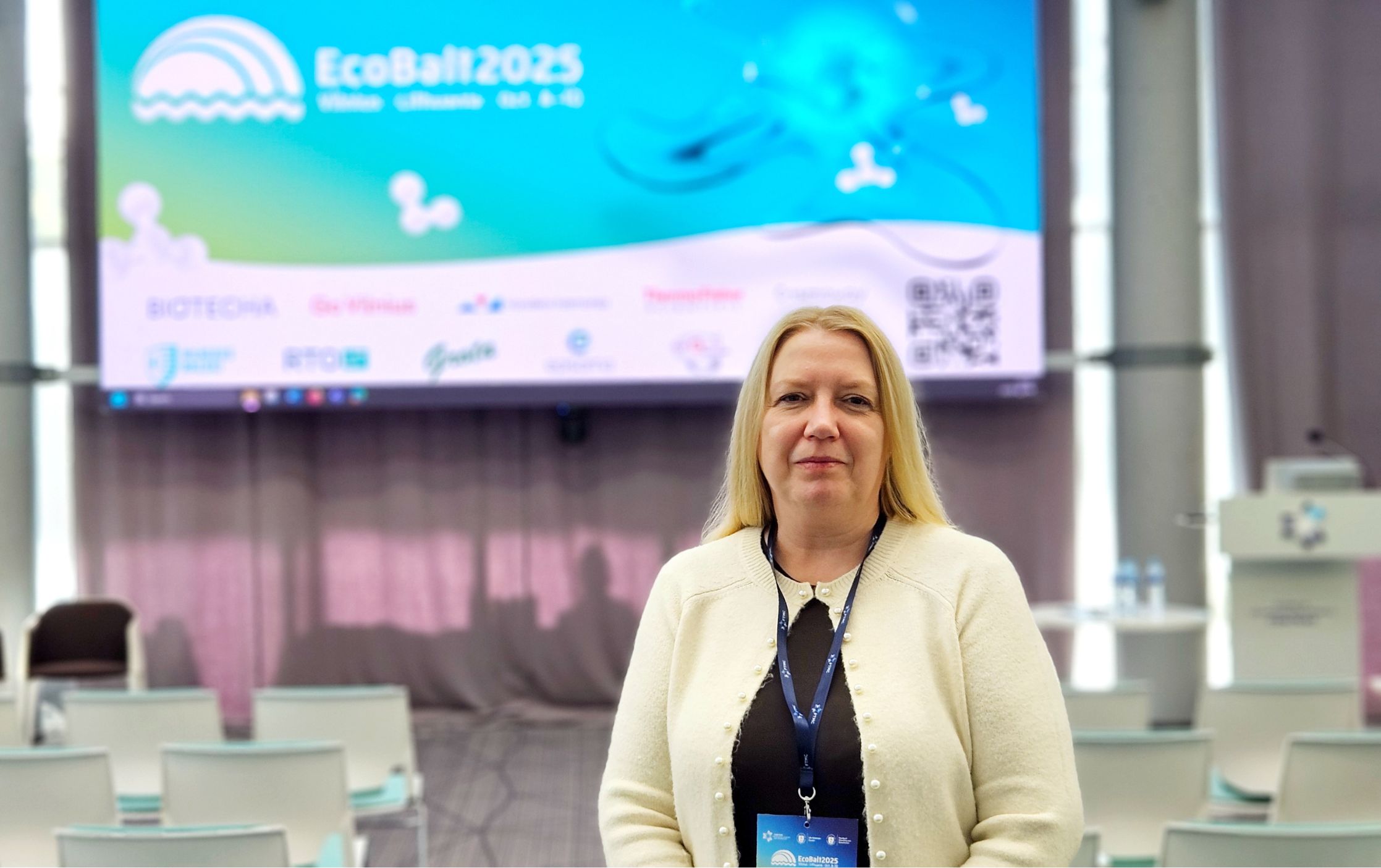
The Faroe Islands – The Future of Eco-Friendly Construction? Interview with Karin Habermehl-Cwirzen
Situated between Iceland and Scotland, the Faroe Islands are a remote and sparsely populated archipelago, home to… sheep. A lot of sheep. Yet this peaceful image does not tell the whole story: beneath the calm surface, academic life is thriving, scientific research is advancing, and the University of the Faroe Islands is nurturing a new generation of researchers.
One of the leading academics at the university’s Faculty of Science and Technology is Associate Professor Dr Karin Habermehl-Cwirzen, who was among the keynote speakers at the EcoBalt 2025 conference held in Vilnius from 8–10 October.
Her research tackles an issue that concerns us all: how to develop sustainable and environmentally friendly construction materials. To this end, Assoc. Prof. Habermehl-Cwirzen is exploring the potential of Faroe Islands basalt and local construction waste (for instance, recycled concrete).
In order to make these materials “active”, that is, suitable for practical use, the Associate Professor and her colleagues employ high-energy ball mill grinding technology. In this process, rocks and other materials are placed in a specialised machine containing rapidly rotating balls that crush and grind the material until it becomes extremely fine. This “activates” the material, enhancing its reactivity in chemical processes and allowing it to be used in applications such as cement or concrete production.
According to the University of the Faroe Islands researcher, the experiments have already yielded promising results, and the work has attracted considerable interest from industry representatives.
Learn more in our conversation with Karin Habermehl-Cwirzen.
.jpg)
(The Faroe Islands. Photo: Canva.com)
At the beginning of your talk you mentioned that much of the material for cement and concrete is shipped from Norway, and the Faroe Islands have great potential in their unused rock resources.
Yes, exactly. In the Faroe Islands, they mainly import stones and rocks for concrete from Norway. And from Denmark, where there’s a large cement producer, they order most of their cement. Everything has to be shipped, because there is no cement producer in the Faroe Islands – we don’t have the raw material for it.
But we do have lots of rocks. It’s like a saying: in the Faroes, we have lots of fish, lots of rocks, and lots of sheep (smiles). So it makes sense to use aggregates or stones from the Faroe Islands.
However, as I showed in one of the pictures, there are many different kinds of stones – not just one type. For example, in Norway they have granite, which is very hard and very good material. We have basalt and other kinds of stone, and people sometimes say, “Oh, perhaps it’s not so good.” So we want to study it and be able to tell concrete companies: “You can confidently use this material for your concrete mix – it will last and perform well.”
And so far, what is the potential of Faroese basalt? Can it be used as an alternative to imports?
We hope to replace all or most of the Norwegian aggregates with Faroese ones. As I showed, we are producing about the same amount of stones in the Faroe Islands. For example, during tunnel construction, a lot of stone is excavated that is not being used – it’s just lying around. Instead of letting it go to waste, we could use it, for example, to replace aggregates imported from Norway.
And if you can activate it, you can even partially mix it into the concrete as a replacement for sand or cement.
When could this come to industry?
We’re already collaborating with local industry. There are actually many concrete producers in the Faroe Islands – surprisingly many for such a small country. There’s even a company producing precast concrete. You know, instead of pouring concrete on the building site, they make the molds and pour the concrete in their factory. For a country of 55,000 people, that’s quite impressive!
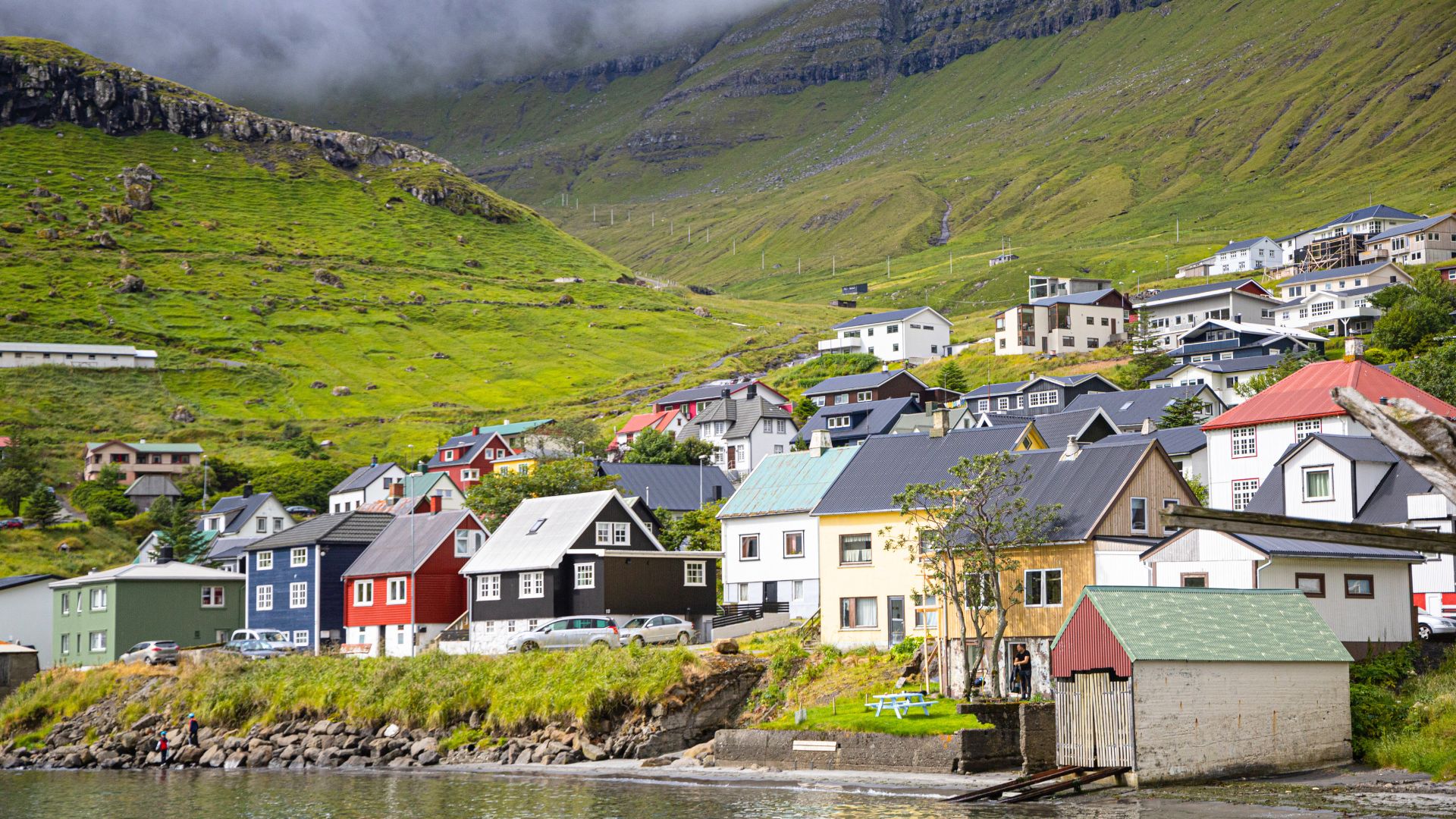
(The Faroe Islands. Photo: Canva.com)
And another topic was reusing concrete from old buildings — you showed an example of “reusing” the old prison ir Faroe Islands. Can you tell us more about that?
This idea was developed in several places around the same time. One of the front-runners was my old laboratory in Sweden, where my husband still works. They started experimenting with recycling old concrete and found that it actually works.
You take old concrete – imagine you see a piece with stones and cement paste between them. That paste is made from cement and water. You can take this hardened cement paste, grind it in the mill, and it becomes active again. Normally you’d think that cement which has already reacted wouldn’t react again – but it does.
There are also studies showing that cracks in concrete can sometimes close themselves. When water enters the crack, it can react with unreacted cement particles still inside, causing the crack to seal.
When you grind the old cement particles, you expose new surfaces and sometimes even change their structure. If you have a crystalline structure, it can become more amorphous, which gives it higher reactivity. You also introduce dislocations or “errors” in the material, or increase its surface area – both make it more reactive.
And where can this recycled cement be used?
In principle, anywhere – as long as you know what strength you’re getting, because you don’t want houses collapsing. But it can be used in all kinds of concrete structures.
Do you have any connections with industry that are interested in this research?
Yes. One example is wind towers. Their bases are made of concrete, and that’s a huge amount of material just lying there. So you could recycle and reuse it. And when you remove old wind towers, you could also extract and recycle the base.
“Double green,” so to speak.
Exactly. Of course, the ball milling process uses energy, so we’re applying for European funding to study that. We want to collaborate with an electricity company to calculate how much energy is needed, and whether it’s better to use renewable wind energy or to run the mills at night when electricity demand is low. So yeah, lots of, lots of thoughts and developments.
Interview by Simonas Bendžius