- Home
- News & Events
- News
Towards Next-Generation Technologies: Research Project Partners from FTMC and National Cheng Kung University Meet in Taiwan
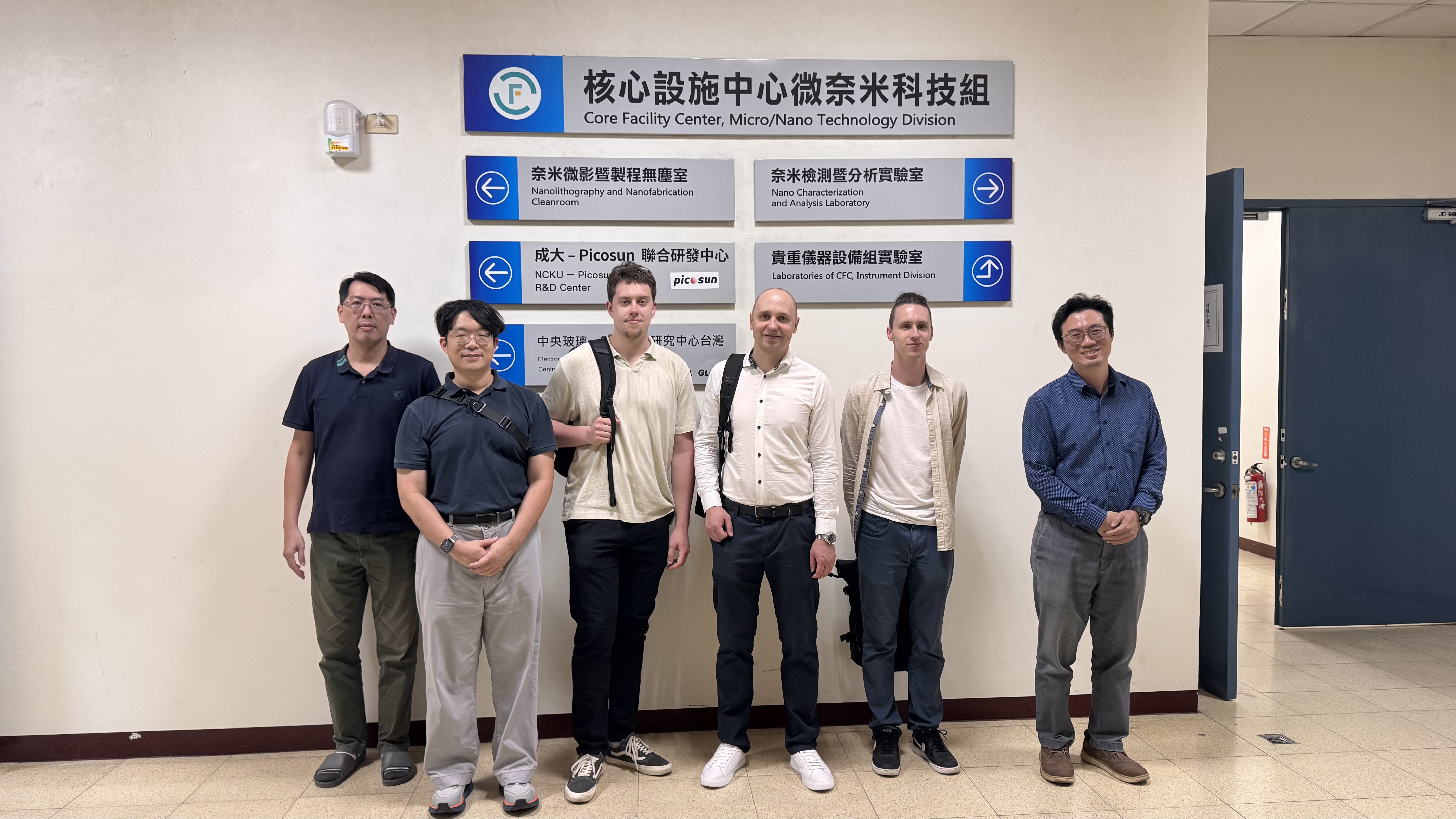
Dr Evaldas Stankevičius, a researcher at the FTMC Department of Laser Technologies, together with PhD students Kernius Vilkevičius and Rodrigas Liudvinavičius, visited Taiwan, where they met with partners from the Department of Photonics at National Cheng Kung University within the framework of the joint Lithuanian-Taiwanese project “Micro/Nano Metasurfaces for Efficient Plasmonic Nanolaser Development”.
“The aim of this project is to develop a next-generation plasmonic nanolaser platform by combining advanced laser-fabricated metasurfaces with ultra-thin transition metal dichalcogenide semiconductors that are only a single atomic layer thick.
Such technologies could enable the creation of extremely compact, tunable and efficient light sources, which in the future could be integrated into optical chips and compact photonic devices,” says Dr Stankevičius.
Within the project, the FTMC Plasmonics and Nanophotonics Laboratory is represented by Dr Evaldas Stankevičius together with students Kernius Vilkevičius, Rodrigas Liudvinavičius, and Vita Petrikaitė. The Taiwanese partner team includes Dr Yu-Hsun Chou, Dr Pin-Chieh Wu, and PhD students Wing-Sing Cheung, Chiao-Chih Lin, Po-Sheng Huang, and Hsiu-Ping Su.
According to Dr Stankevičius, the metasurfaces being developed during the project may be important not only for fundamental studies of light-matter interaction, but also for practical applications:
“In the future, such technologies could contribute to the development of smaller and more efficient optical components, advanced display technologies, LiDAR systems, ultra-fast optical computing technologies, and more secure information transmission solutions.
The project also aims to develop large-scale nanostructure fabrication based on artificial intelligence methods, which could accelerate the industrial adoption of these technologies.”
(Photo: FTMC)
During the visit, the partners discussed the results achieved so far, the next stages of collaboration, and planned experiments. Dr Stankevičius also delivered a lecture at National Cheng Kung University on plasmonic structures fabricated using direct laser writing and their potential applications.
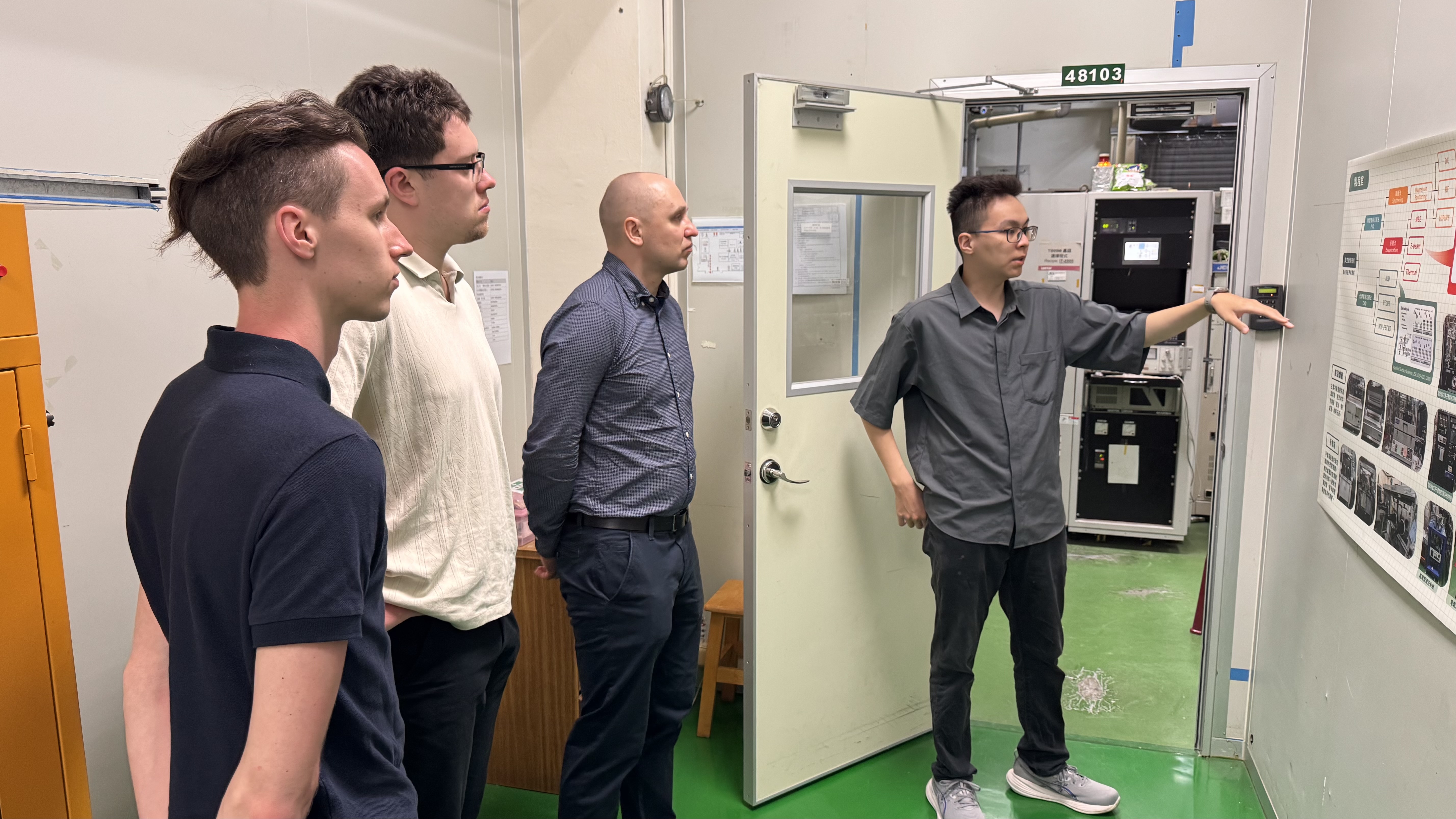
The Lithuanian delegation additionally became acquainted with the Taiwanese partners’ research infrastructure, available equipment, and the nanophotonics technologies under development.
“The visit strengthened collaboration between Lithuanian and Taiwanese scientists and created favourable conditions for further joint research in the fields of plasmonics, nanophotonics, and nanolasers,” says the FTMC physicist.
Financial support was provided by the Research Council of Lithuania (LMTLT), contract No. S-LT-TW-25-3
Info: FTMC