- Home
- News & Events
- News
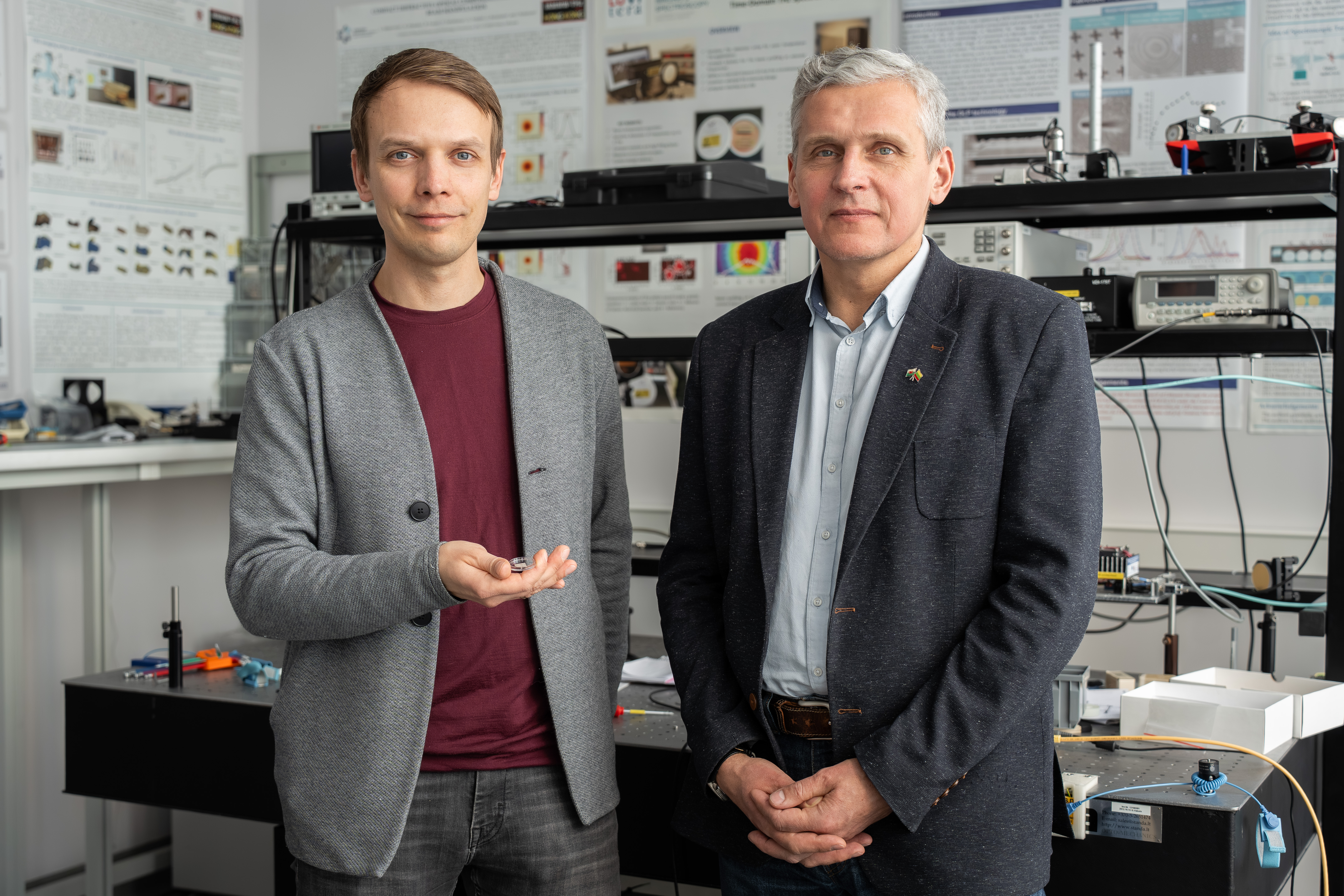
Turning Heat Waste into Electricity: FTMC Physicists Reveal a Breakthrough for Electronics
One of the biggest joys in a scientific career is the moment when your discoveries turn into real, functioning devices. A recent example is a spectrally selective, directional thermal electromagnetic radiation emitter, patented in 2025 by physicists Dr Irmantas Kašalynas and Dr Vytautas Janonis from the FTMC Department of Optoelectronics.
It is the first invention of its kind in the world.
What makes it special? Ordinary thermal light sources – think of a light bulb – emit light in all directions and across the full spectrum of rainbow colours. That is why a room lights up instantly when you turn on the switch, allowing us to identify the colours of visible objects.
Scientists, however, sometimes need a different type of light: one that does not spread in all directions but instead forms a focused beam of a single selected colour. This type of light is known as coherent radiation, like the light produced by lasers. And this is exactly what the FTMC emitter can achieve.
Tiny Grooves, Big Impact
So how does it work? In simply terms, the device consists of a small gallium nitride crystal with microscopic grooves etched on its surface. These grooves are essential.
When the crystal is heated on a matchbox‑sized heater, the grooves make it emit highly directional far‑infrared radiation, with a wavelength of 17.5 micrometres or a frequency of 17 THz which is invisible to the human eye.
The grooves can be shaped differently. A typical diffraction grating made of straight lines disperse radiation at various angles, forming a rainbow of colours. In contrast, our source is composed of circular grooves that direct the infrared beam at the selected wavelength straight upward.
.jpg)
(Photo: Bernadeta Sisimbajevė / FTMC)
“These tiny structures on the crystal don’t just shine individually – you can arrange many of them side by side, designed with identical or different geometries. Together, they shine like miniature torches in a normal direction, creating small, focused beams of light,” explains Dr I. Kašalynas.
“And because we use conductive gallium nitride, we don’t even need an external heater. In our experiments, we simply attached contacts and passed an electric current through the crystal, allowing it to heat itself. Its surface then emitted directional light at a single wavelength,” adds Dr V. Janonis.
Gallium nitride is a wide bandgap semiconductor, chosen for a reason. It is one of the key materials behind the European Chips Act – the EU’s initiative to strengthen the semiconductor ecosystem. Although highly important, gallium nitride is also costly and rare. The Lithuanian researchers therefore thank their partners at the Institute of High Pressure Physics (UNIPRES) of the Polish Academy of Sciences for supplying exceptionally high-quality gallium nitride crystals that enabled the practical realization of the source (published in Optical Materials Express Vol. 13, Issue 9).
Moreover, the European patent by Kašalynas and Janonis states that similar radiation sources could also be produced using other polar semiconductor crystals, such as gallium arsenide or indium phosphide.
A Vision: From Home Offices to Outer Space
The invention is patented - but how could it be used in everyday life? FTMC researchers are exploring waste heat management: capturing excess heat from electronic devices and reusing it for energy recycling instead of letting it disappear.
These tiny and solid grooved crystal sources can be integrated into general‑purpose electronics, multiplied easily, and readily modulated. That means that heat that would normally be lost could be transformed into electricity and directed exactly where it is needed.
“One of the most exciting applications is thermophotovoltaics: we could transfer heat that usually accumulates in certain electronic components into optical elements. Consider satellites – when one part heats up, its waste heat could be redirected to a sensor, a short‑range communication device, or another component,” says Dr Vytautas Janonis.

(Photo: Pexels.com)
Dr Irmantas Kašalynas offers a more everyday example:
“Computer microprocessors generate heat. With our surface‑patterned crystals, this radiation could be directed straight to a battery. In this way, waste heat would be converted into electrical energy – and the device could power itself.”
And back to space: because the grooved structure patented by the Lithuanian team is relatively simple, it can cover very large areas. The technology can be scaled up as much as we like – in theory, it could be even used to cover entire buildings. This could radiate unwanted heat from Earth into space, providing passive cooling for houses.
The concept even extends to biology: molecules that absorb specific wavelengths could be selectively heated with targeted radiation – either to accelerate desired chemical reactions or to destroy harmful cells.
What’s next? FTMC researchers plan to expand and deepen their experiments, further improving their invention so that future applications can become reality as soon as possible.
Written by Simonas Bendžius