- Home
- News & Events
- News
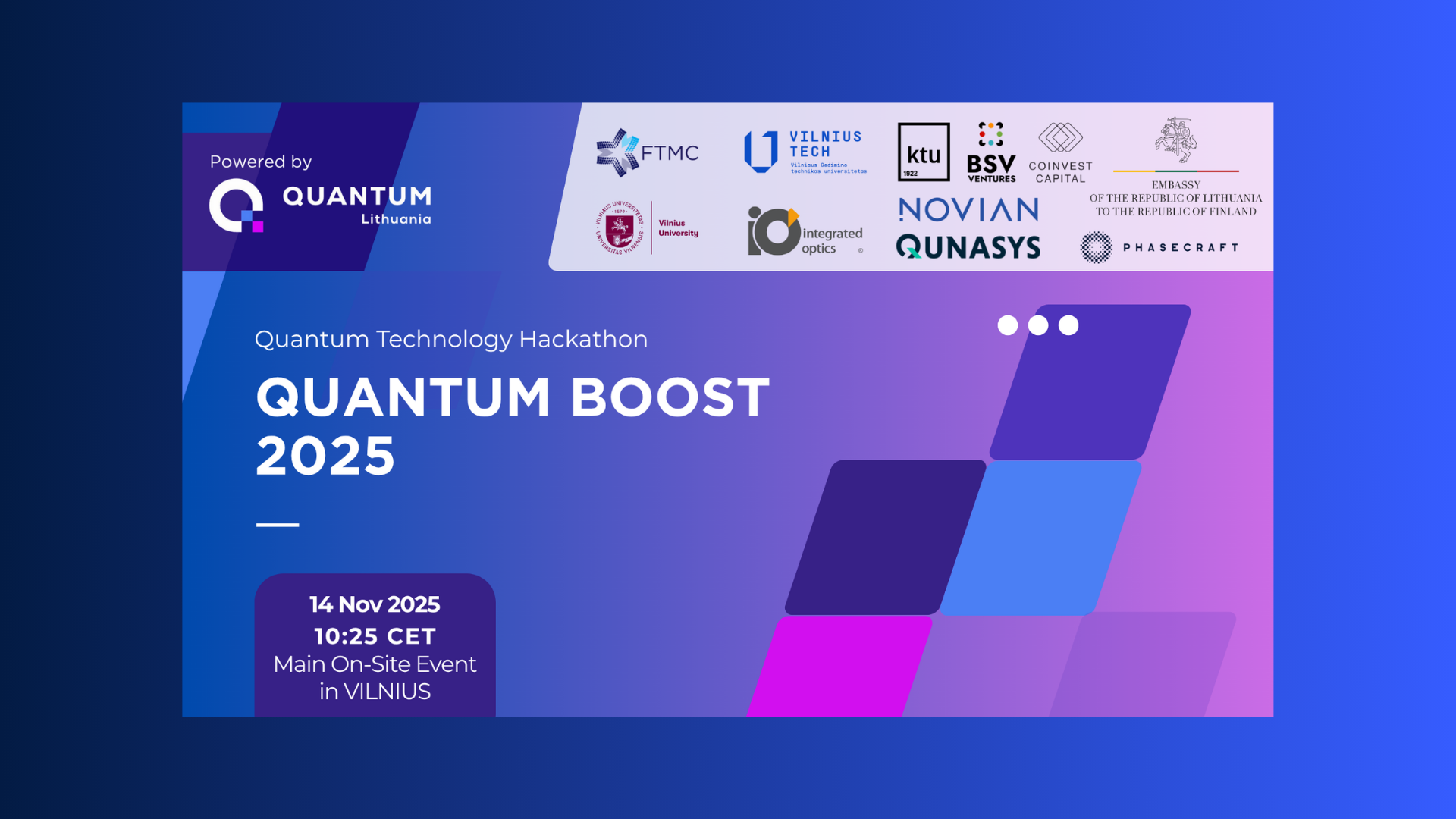
Vilnius to Host the First Quantum Hackathon in the Baltics: International Talents Tackle Global Challenges
Quantum technologies are no longer the future – they're ready to transform security, medicine, finance, energy, and communication. Brilliant minds across science and industry are ready to make a difference.
This is the message behind Quantum Boost 2025, an international quantum technology hackathon taking place in Lithuania, organized by the Quantum Lithuania, Lithuanian Quantum Technologies Association. It is the first event of its kind in the Baltic region, uniting scientists, start-ups, and industry leaders.
Over the past few weeks, participants from Lithuania and abroad have been tackling pressing global issues remotely using quantum technology methods. The teams will present their final ideas in Vilnius on 14 November, during the event’s grand finale. Everyone interested in quantum technologies is invited to attend, support their favorite team, and meet Professor Philip Walther from Austria – one of the pioneers of quantum computing!
Originally planned as a Nordic–Baltic hackathon, Quantum Boost 2025 has unexpectedly attracted participants from nine countries across three continents. Among them are prominent universities and research centers: the University of Oxford (UK), KTH Royal Institute of Technology and Stockholm University (Sweden), the University of Oulu (Finland), Université Paris-Saclay (France), Riga Technical University (Latvia), Alexandria University (Egypt), the African Institute for Mathematical Sciences (Ghana), Çanakkale Onsekiz Mart University (Turkey), as well as the Center for Physical Sciences and Technology, Vilnius University, and VILNIUS TECH (Lithuania).
112.jpg)
(Center for Physical Sciences and Technology, where the grand finale of the first quantum hackathon in the Baltics will take place. Photo: Judita Vadeikė / FTMC)
“Throughout October and November, 13 teams are working on key quantum technology challenges – from GPS-independent navigation and quantum-secure communications to optimization algorithms for logistics and innovations in healthcare,” says Dr Mažena Mackoit-Sinkevičienė, physicist at FTMC and one of the hackathon organizers.
“Among the challenges are developing a quantum or hybrid model for identifying toxic drug candidates, assessing the efficiency of SVM kernels for molecular datasets, devising quantum security solutions for the financial sector, and optimizing energy systems using quantum methods,” explains the physicist.
Participants are being mentored by leading experts in the field, including Dr Ieva Čepaitė (Phasecraft, UK), Laurynas Vanagas and Adam Wesołowski (QunaSys, Japan), Eglė Jašinskaitė (BSV Ventures, Lithuania), Austėja Lazaravičiūtė (Coinvest Capital, Lithuania), and the hackathon’s technical challenge creators Dr Marco Marcozzi (Vilnius University) and Dr Šarūnas Grigaliūnas (Kaunas University of Technology).
“It is symbolic that the first quantum technology hackathon in the Baltics is being held here at the Center for Physical Sciences and Technology (FTMC) – the place where Lithuania’s technological future is being built,” says Mantas Skaržinskas, FTMC innovation manager, PhD candidate, board member of Quantum Lithuania, and lead organizer of Quantum Boost 2025.
“We initially planned a Nordic–Baltic event – that seemed achievable. Now we have an intercontinental hackathon, which feels incredible. Three continents, 13 teams from nine countries, all competing for the chance to grow at cosmic speed together with Lithuania’s venture capital firms. This event proves that Lithuania can be a place where science and business truly speak the same language,” adds Skaržinskas.
The six strongest teams will have the opportunity to present their ideas at the grand finale on 14 November, competing for cash prizes and the chance to secure investment from BSV Ventures (up to €500,000) and Coinvest Capital (up to €750,000, with an additional €2 million available for follow-on investments).

(Professor Philip Walther. Photo: Der Knopfdrücker)
The finale will take place at FTMC in Vilnius. Before the team presentations, attendees can look forward to a special programme featuring expert talks and a panel discussion, “From Theory to Application: Bridging Quantum Research and Real-World Impact.”
The highlight of the event will be a keynote lecture by Professor Philip Walther from the University of Vienna, a pioneer in photonic quantum computing. Earlier this year, his team developed a photonic quantum computer capable of operating in space conditions.
The first experiments are expected to test the efficiency of quantum computing in space environments and lay the foundation for future systems capable of real-time satellite-based analysis using edge computing principles.
Other distinguished guest speakers include:
- Jenny Hasu, from Finland’s VTT Technical Research Centre, one of Europe’s leading research institutions. She heads the Department of Digital Technologies, focusing on microelectronics and quantum technologies.
- Assoc. Prof. Dr Saulius Vaitiekėnas, from the Niels Bohr Institute at the University of Copenhagen, who leads the Quantum Matter Lab. His research explores how superconductivity, magnetism, and semiconductors can be combined to create new quantum materials and devices.
The finale presentations will be evaluated by a panel of experts and innovation leaders:
- Prof. Dr Mantas Šimėnas – researcher at Vilnius University Faculty of Physics, developing next-generation quantum technology methods to enhance electron paramagnetic resonance (EPR) spectroscopy sensitivity by several orders of magnitude through quantum-limited microwave amplifiers.
- Dr Tadas Paulauskas – scientist at FTMC Department of Optoelectronics, leading research into defect-based quantum technologies in semiconductors for advanced quantum communication, sensing, and memory applications.
- Dr Karolis Stašys – Head of FTMC Department of Innovation; Lithuania’s representative at NATO Science and Technology Organization (NATO STO); co-developer of the first quantum cascade lasers in Lithuania.
- Prof. Dr Remigijus Paulavičius – professor at Vilnius University Faculty of Mathematics and Informatics, Head of the Blockchain and Quantum Technologies Group, and vice president of the Quantum Lithuania.
- Andrius Milinavičius – managing partner at the venture capital fund Baltic Sandbox Ventures.
- Viktorija Trimbel – CEO of Coinvest Capital.
Everyone interested is kindly invited to follow the event in person or online, and register in advance at boost.quantumlithuania.eu.
Organizers' info