- Home
- News & Events
- News
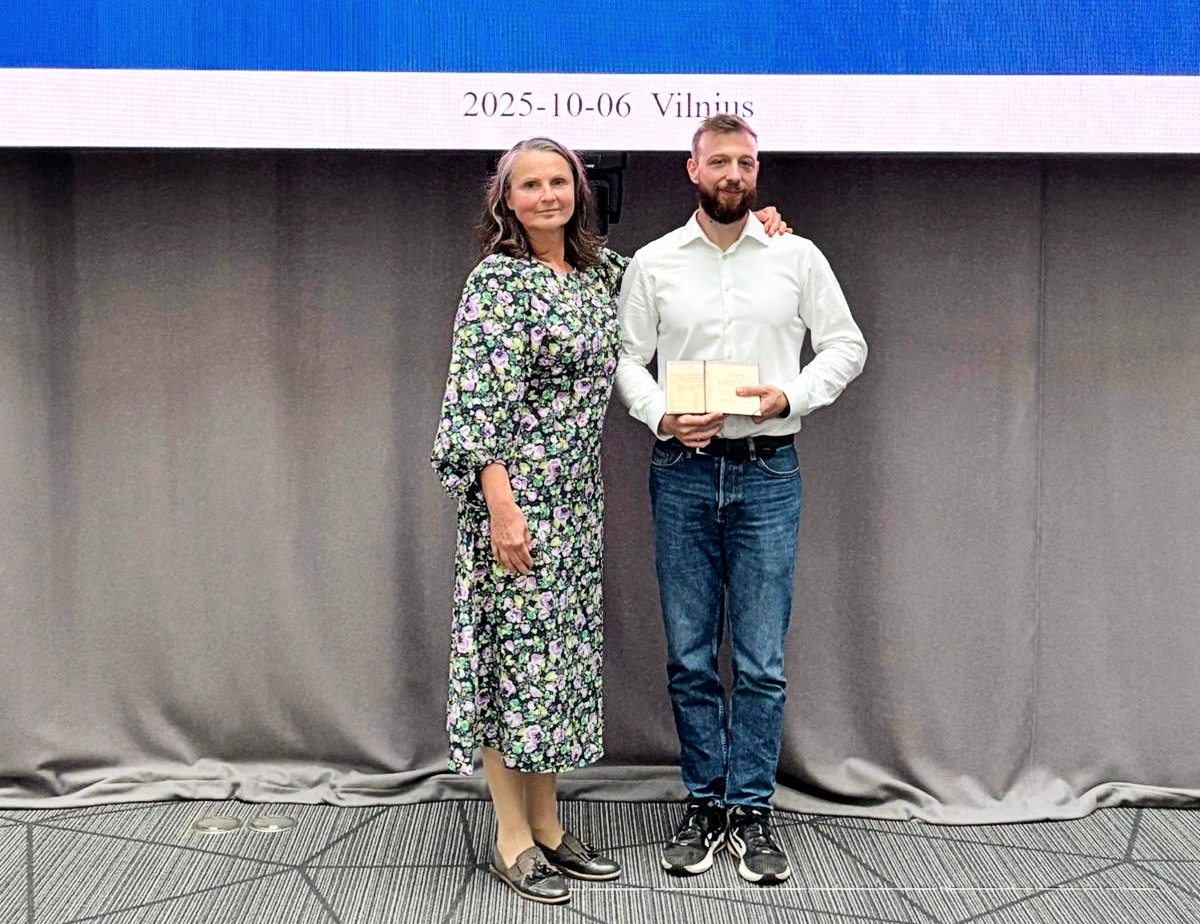
World-First GaAsBi-Based VECSEL Laser: Andrea Zelioli Earns PhD
FTMC has another talented PhD in Natural Sciences! On 6 October, Optoelectronics Department physicist Andrea Zelioli successfully defended his dissertation “Growth and Investigation of A3B5 Quantum Structures for VECSELs” (academic supervisor: Dr Renata Butkutė).
Congratulations to our colleague – may this mark the beginning of a brilliant and successful journey!
Andrea’s dissertation focuses on a special type of semiconductor laser called a Vertical-External-Cavity Surface-Emitting Laser, or VECSEL. These lasers are interesting because they combine high beam quality with the possibility of producing large amounts of power and light at different wavelengths. They are already used in fields like communications, medicine, and research, but their performance still depends strongly on the quality of the materials that make them work.
“In particular, I studied two materials that can serve as the active “light-generating” parts of these lasers: indium gallium arsenide (InGaAs) and gallium arsenide bismide (GaAsBi). Each has advantages and challenges. InGaAs is well established but challenges arise when pushed to longer wavelengths, while GaAsBi is newer and offers special properties like thermal stability, but it is very difficult to grow without defects.
The essence of my work was therefore to improve the way these materials are grown and used inside the laser. I optimized the growth conditions, studied how defects form and how to reduce them, designed new structures for the laser’s active layers, and in the end built and tested complete VECSEL devices,” explains the physicist.
.jpg)
(Molecular beam epitaxy (MBE) equipment, where A. Zelioli and his colleagues grow crystalline materials for lasers. Photo: Hernandez & Sorokina / FTMC)
One of the important results of his work was showing that mapping the light emission from InGaAs quantum wells can reveal where dislocations, which are crystal defects, are located. This is a new and relatively simple method for evaluating material quality, which is very useful for laser development. Zelioli also found ways to minimize these dislocations by carefully choosing growth conditions and barrier designs.
“While studying another material, GaAsBi, I investigated how it loses efficiency, and created a modified model to describe its behavior more accurately. This helped explain which processes limit the performance of GaAsBi and guided the optimization of its growth. I also designed and tested different barrier geometries that improved the way carriers are confined, lowering the energy needed to start lasing and increasing the light output of laser diodes based on this compound.
Finally, one of the key outcomes of my PhD was the fabrication of the very first GaAsBi-based VECSEL. This device successfully produced laser light from a large pumped area without the need for special cooling. This is a significant step forward, because it shows that GaAsBi can really be used in practical laser devices, not just in theory”, says the FTMC researcher.
.jpg)
(Photo: Canva.com)
Why might this work be interesting or useful to the wider public? According to Zelioli, lasers have become a crucial technology in everyday life. They are not only used in research labs, but also in medical imaging and treatment, in communications networks, in industrial cutting and processing, and even in entertainment devices.
The improvements Andrea worked on could make future lasers more efficient, more stable, and easier to produce at different emission wavelengths (colors), in the near-infrared range where many applications exist.
“For the public, this could translate into safer and more reliable medical diagnostics, more efficient internet and communication systems. For example, a more thermally stable and efficient laser can make portable medical devices smaller and cheaper, or allow fiber-optic communication systems to work without expensive cooling systems.
Beyond direct applications, this research also expands the scientific understanding of new semiconductor materials like GaAsBi. This knowledge may open doors to technologies we don’t yet imagine today, just as early laser research in the 1960s eventually led to the countless laser applications we take for granted now. In this sense, my work contributes to both current needs and future possibilities,” concludes the new PhD.
You can read the dissertation by following this link.
Info: FTMC