- Home
- Structure
- Scientific Divisions
- Department of Nuclear Research
- Equipment
- ION BEAM TECHNOLOGY
- TANDENTRON 4110A ION ACCELERATOR
TANDENTRON 4110A ION ACCELERATOR
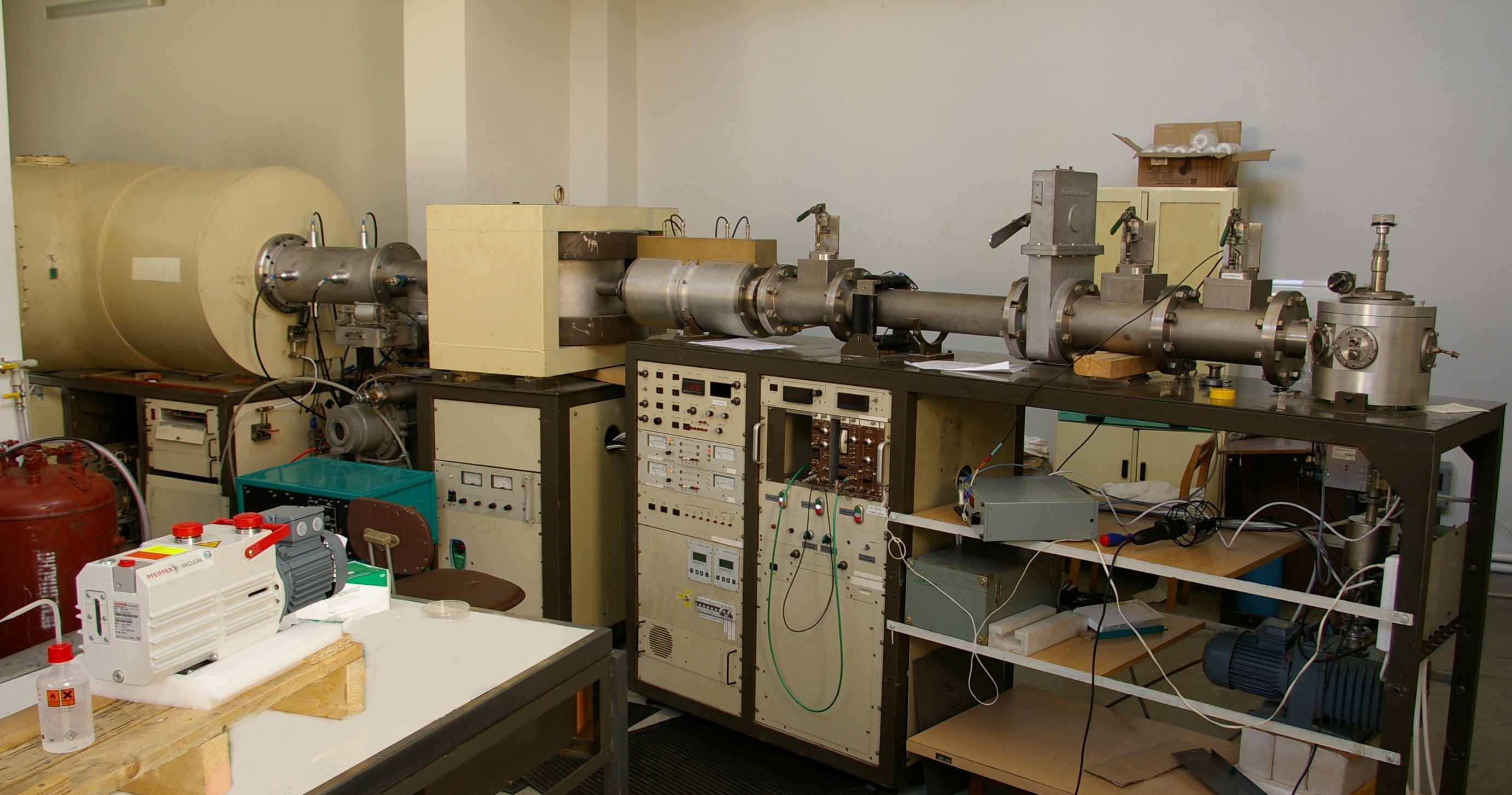
The Tandemtron 4110A accelerator (General Ionex Corp.) is a versatile analytical instrument designed for ion implantation and ion beam analysis techniques such as Rutherford Backscattering Spectrometry (RBS), Particle-Induced X-ray Emission (PIXE), and others analytical techniques. It is a tandem-type accelerator in which both the low- and high-energy ends of the system are maintained at ground potential.
The system consists of a cesium sputtering Hiconex 834 negative ion source, acceleration tubes, vacuum systems, focusing elements, and analytical components. The ion source reliably produces microampere-intensity negative ion beams from a wide range of solid elemental materials.
Negative ions of the desired species are selected using an inflection magnet, focused by an Einzel lens, and directed into the accelerator. The acceleration section is housed within a pressure tank filled with sulfur hexafluoride (SF₆) gas. This tank contains the accelerator tube system, terminal gas stripper assembly, focusing lens system, and a precisely regulated 1 MV solid-state power supply.
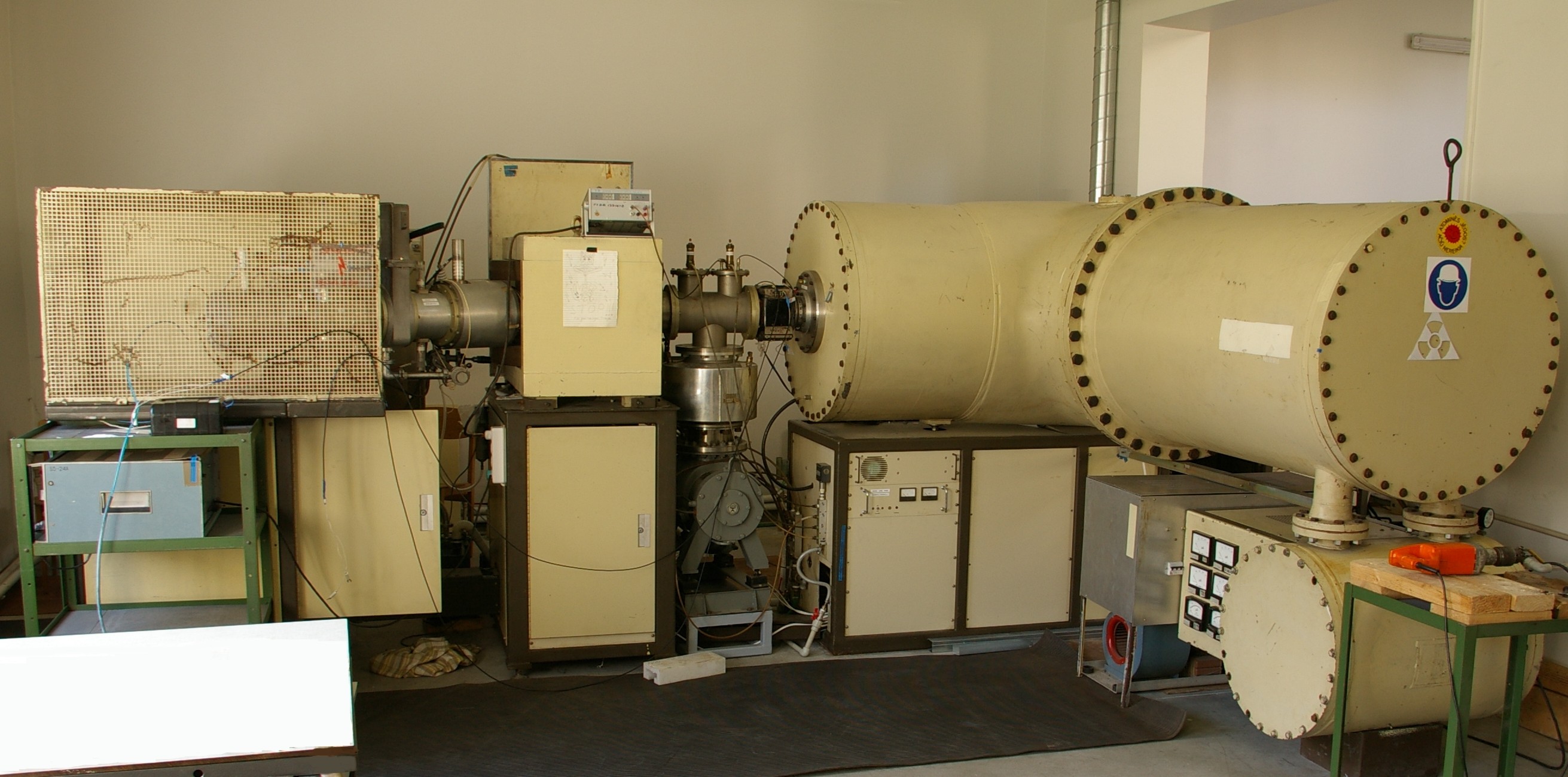
Negative ions are accelerated toward the high-voltage terminal, where electrons are stripped in a gaseous charge-exchange cell, producing positive ions. These ions obtained are then repelled by the same high-voltage potential and accelerated toward ground potential. As a result, particle beam energies of up to 2.0 MeV for singly charged ions and up to 5.0 MeV for quadruply charged ions can be achieved.
After acceleration, an electrostatic quadrupole lens provides a finely focused beam with minimal aberrations. A magnetic analyzer removes neutral particles and selects ions with the desired charge state. The resulting beam is then directed into the analytical chamber containing the sample.
High vacuum conditions are maintained using three forevacuum pumps and four turbomolecular pumps.