- Home
- Innovations
- Technology Transfer & Networking
- Technologies
- TRUE ZERO-ORDER WAVEPLATES BASED ON ALL-SILICA THIN FILMS
TRUE ZERO-ORDER WAVEPLATES BASED ON ALL-SILICA THIN FILMS
DESCRIPTION, INNOVATION AND ADVANTAGES
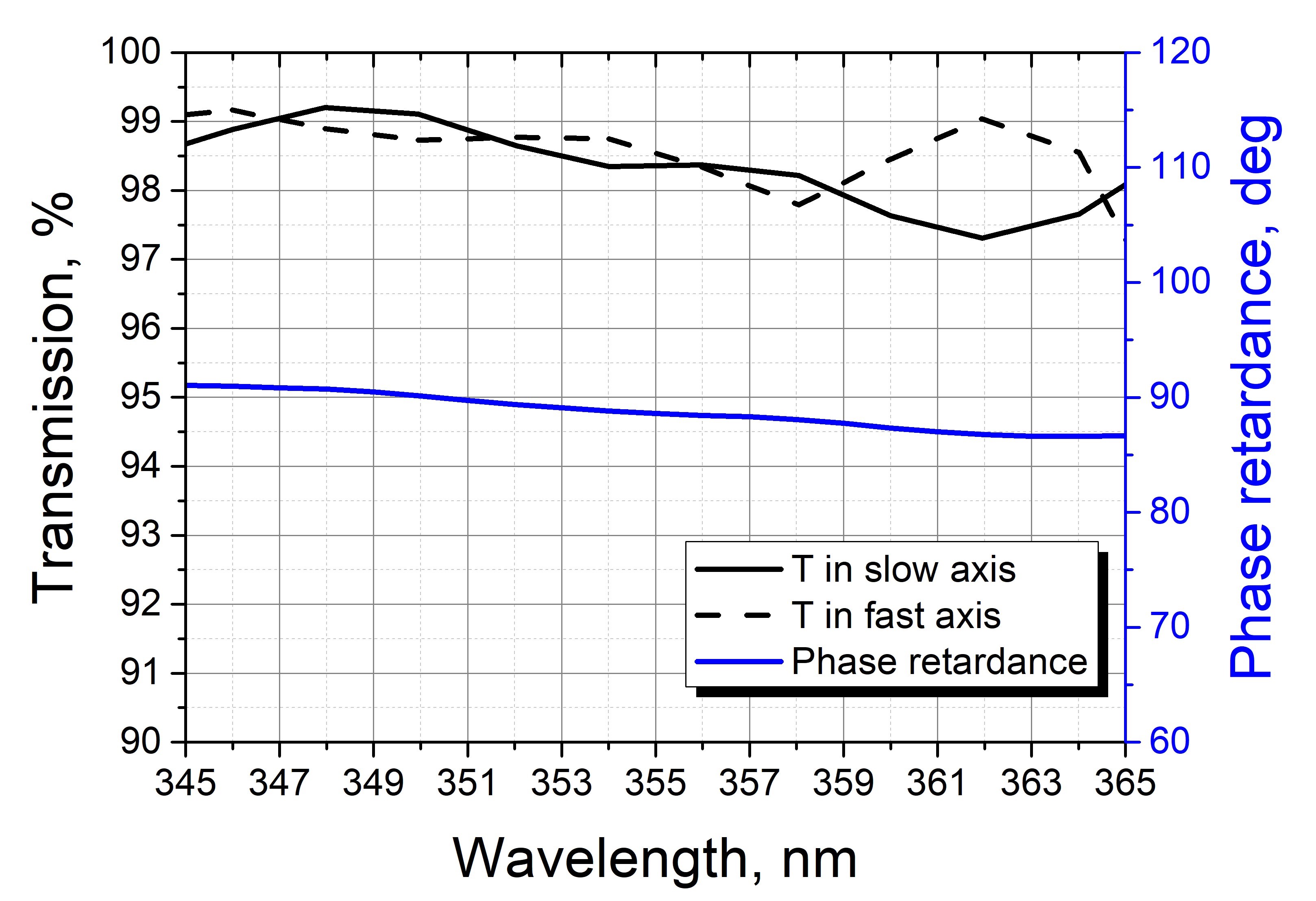
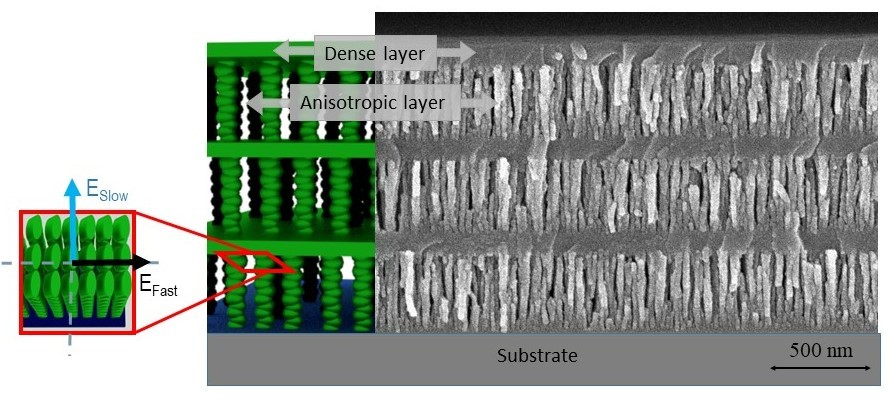
The glancing angle deposition technique is employed to form nanostructured anisotropic layers by evaporating amorphous materials. Placing the substrate at an oblique angle induces the self-shadowing effect, which causes the growth of columnar nanostructures with elliptical shape cross-sections. The combination of such porous birefringent layers with comparatively small refractive index and dense isotropic thin films with higher refractive index allows forming interference coatings with required properties – high transmission or high reflection. Furthermore, due to the birefringence in anisotropic layers, the needed phase delay difference of perpendicular polarizations can be achieved to form waveplates. Low optical losses and high transparency (T~99%) can be achieved while indicating the potential to withstand high laser fluence of 40 J/cm2 in a nanosecond regime at 355 nm wavelength. Moreover, true zero-order waveplates can be produced for any wavelength in the spectral range from UV to IR. Since it is a thin film-based component, it can be coated on any surface: nonlinear crystals, mirrors, glasses etc. The aforementioned flexibility allows applying such waveplates in both – large high-power facilities and microsystems.
CURRENT STAGE OF DEVELOPMENT*
Under development /laboratory tested.
INTELLECTUAL PROPERTY RIGHTS STATUS:
In-house know-how.
TYPE AND ROLE OF PARTNER SOUGHT:
Industrial and (or) research institutions.
CONTACT
Dr. Lina Grinevičiūtė
Phone +37062861306, e-mail: lina.grineviciute@ftmc.lt