Naujienos
2024-01-05
Diatom Antennae Switches Between Light Harvesting and Photoprotection States
A new publication in BBA – Bioenergetics by researchers from our department and international partners reveals how fucoxanthin–chlorophyll protein (FCP) complexes from diatoms regulate the balance between efficient light harvesting and rapid photoprotection. Diatoms contribute roughly a quarter of global primary production, yet the molecular details of their exceptionally fast non‑photochemical quenching (NPQ) have remained elusive.
Using streak‑camera time‑resolved fluorescence spectroscopy across a broad temperature range, we compared isolated FCPa and FCPb complexes with their aggregated forms—an established in vitro model for NPQ. They found that non‑aggregated FCPs fluoresce through a single long‑lived state, whereas aggregates display a far more complex picture involving two emissive states and a powerful quenching pathway. An additional fluorescing state, exhibiting emission in the far-red spectral region, is attributed to a formation of the inter-chlorophyll charge‑transfer state, while the strong fluorescence quenching arises from a dark state linked to incoherent energy transfer from chlorophylls to fucoxanthin.
The study shows that diatom FCPs use design principles reminiscent of plant LHCII—but with distinct microscopic mechanisms. These insights deepen our understanding of how marine algae thrive under extreme light fluctuations and open new avenues for studying NPQ in vivo.
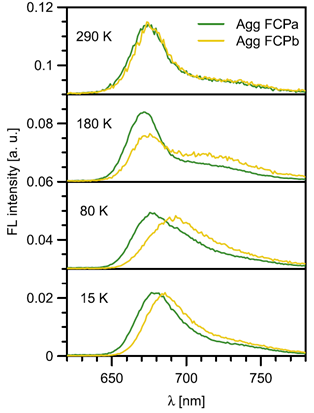
Publication: Fluorescence Quenching in Aggregates of Fucoxanthin–Chlorophyll Protein Complexes: Interplay of Fluorescing and Dark States (https://doi.org/10.1016/j.bbabio.2023.149030 )
Authors: Andrius Gelzinis, Jevgenij Chmeliov, Marijonas Tutkus, Ernesta Vitulskienė, Marius Franckevičius, Claudia Büchel, Bruno Robert, Leonas Valkunas
Acknowledgements: This work was supported by Research Council of Lithuania (LMT Grant No. S-MIP-23-31).
2024-07-08
The fascinating adaptation of photosynthetic organisms to their enormously varying environments attracts considerable interest from scientists from different backgrounds. The light-initiated reactions of photosynthesis occur in polar lipid bilayer membranes, called thylakoids, which in plants and algae are located in chloroplast organelles. In the field of photosynthesis, only a limited number of approaches of super-resolution fluorescence microscopy can be used to probe the architecture of the thylakoid membrane in chloroplasts.
In collaboration with colleagues from CEA Paris-Saclay (France), a home-made microscope – Single Pixel Reconstruction Imaging (SPiRI) – was built. SPiRI yields up to 1.4 gain in lateral and axial resolution relative to confocal fluorescence microscopy, and in the work published in BBA – Bioenergetics this method was used to obtain 2D images and 3D-reconstucted volumes of isolated plant chloroplasts from pea (Pisum sativum), spinach (Spinacia oleracea) and Arabidopsis thaliana to visualize the entire thylakoid network. Due to the resolution gain, and the possibility of easy volumetric reconstruction from sequential plane scanning, SPiRI reveals original information on the structure of the thylakoid membrane in intact, non- chemically fixed chloroplasts. It thus represents a promising technique to explore at the mesoscopic scale the overall volumes of thylakoid network and their evolution during plant adaptation to their environment.
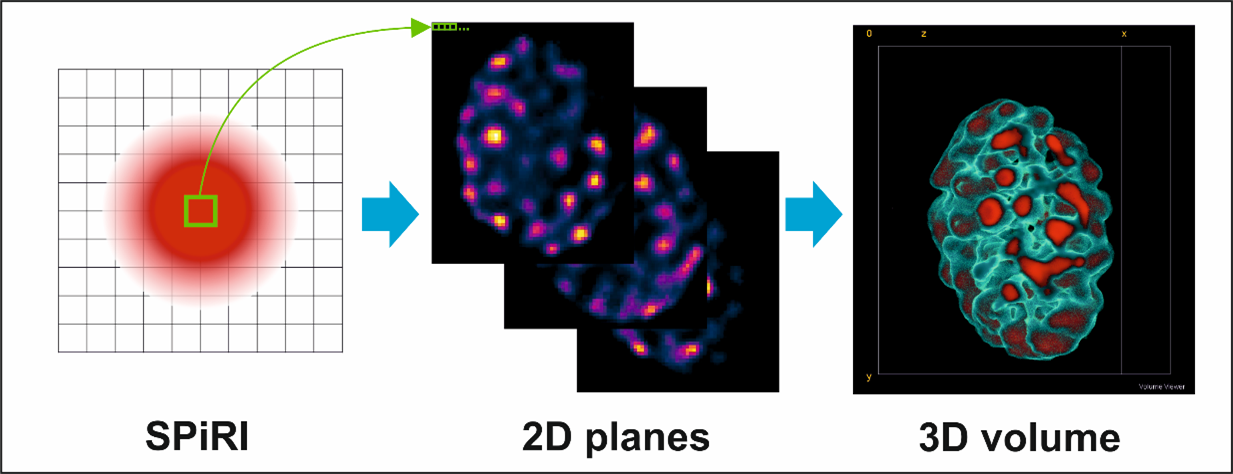
Publication: Functional organization of 3D plant thylakoid membranes as seen by high resolution microscopy (https://doi.org/10.1016/j.bbabio.2024.149493)
Authors: Simona Streckaite, Cristian Ilioaia, Igor Chaussavoine, Jevgenij Chmeliov, Andrius Gelzinis, Dmitrij Frolov, Leonas Valkunas, Sylvie Rimsky, Andrew Gall, Bruno Robert
Acknowledgements: This work was supported by Research Council of Lithuania (LMT Grant No. S-MIP-23-31).
2024-08-08
How Protein Environment Shapes Red Fluorescence in Photosynthetic Lhca4 Complex
A new paper with colleague from CEA Paris-Saclay (France), published in Frontiers in Plant Science, provides a detailed quantum‑chemical analysis of possible charge‑transfer (CT) states in the Lhca4 light‑harvesting complex of Photosystem I. Lhca4 is responsible for the most red‑shifted fluorescence in the photosynthetic antenna of oxygenic organisms, yet the molecular origin of this phenomenon has remained debated for decades.
Using high‑level electronic‑structure calculations combined with a rigorous treatment of protein electrostatics, we identified 19 potential CT states and demonstrated that environmental interactions dramatically reshape their energies. Crucially, the study shows that several chlorophyll dimer can be responsible for the low-energy CT state: the well‑known a603⁺–a608⁻ state is accompanied by another low‑energy CT state, a602⁺–a603⁻, which likely contributes to the observed fluorescence. The study also reveals that subtle changes in the protonation of nearby amino acids can significantly shift CT energies, offering a mechanistic explanation for the multiple conformational states observed experimentally. These insights open new avenues for understanding and engineering red‑shifted light harvesting in plants.
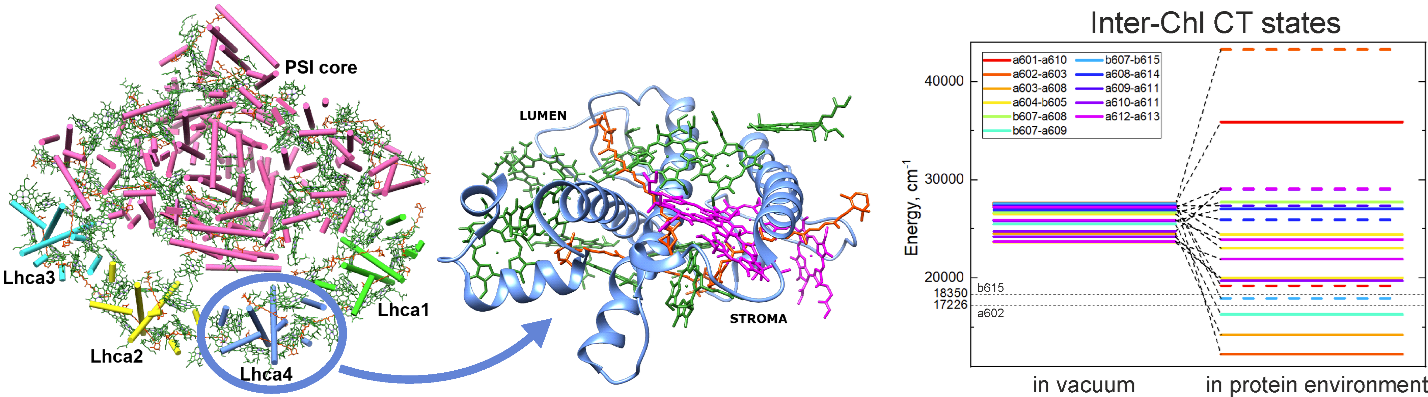
Publication: Environment-dependent chlorophyll–chlorophyll charge transfer states in Lhca4 pigment–protein complex (https://doi.org/10.3389/fpls.2024.1412750)
Authors: Gabrielė Rankelytė, Andrius Gelzinis, Bruno Robert, Leonas Valkunas, Jevgenij Chmeliov
Acknowledgements: This work was supported by Research Council of Lithuania (LMT Grant No. S-MIP-23-31).
2024-10-01
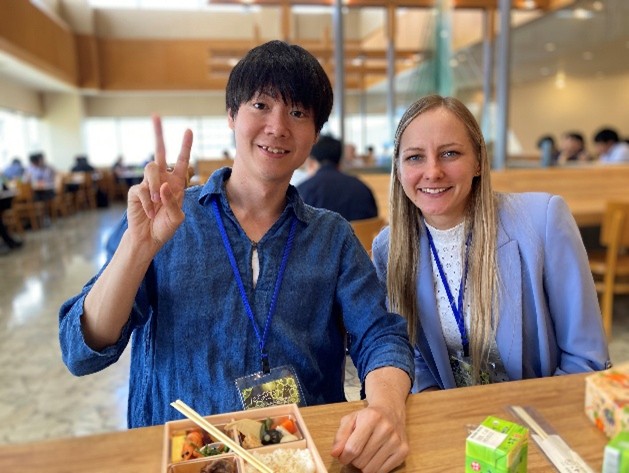
Dr. Simona Streckaitė, senior researcher of MDFS participated in “The 2nd Asia-Oceania International Congress on Photosynthesis” (2nd AOICP), which was held in September, 2024 in Kobe, Japan.
Photosynthesis research is very important globally, as we face rapid climate change. Life on our planet depends on photosynthesis in terms of food, oxygen and fossil fuels, therefore, research on the mechanisms of photosynthesis may provide important information to mitigate the impact of climate change.
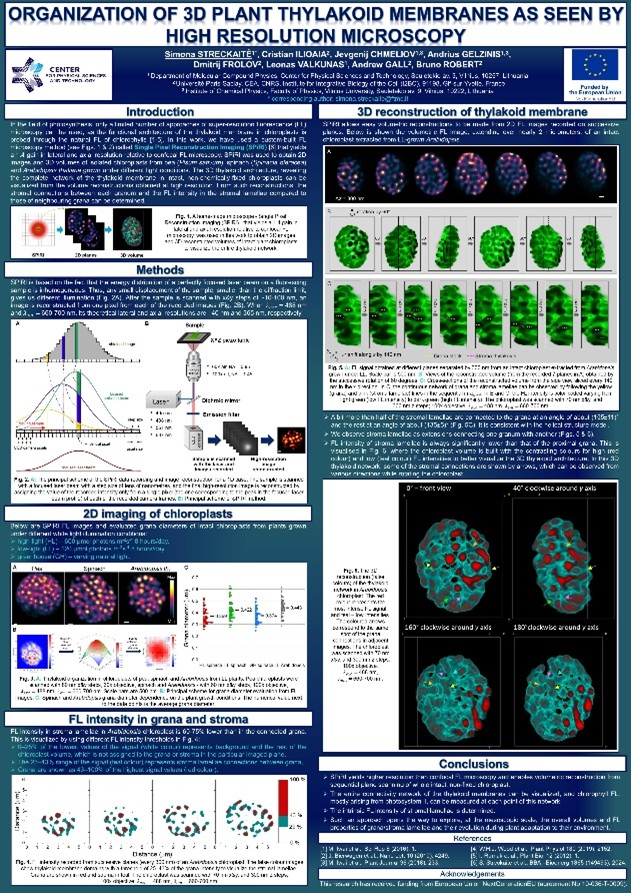
AOICP congress covers broad range of topics from evolution of photosynthesis to detailed studies of its machinery at the molecular level. Dr. Streckaitė presented a poster in this conference, entitled “Organization of 3D Plant Thylakoid Membranes as seen by High Resolution Microscopy”. In this work, she presented a custom-built FL microscopy method called Single Pixel Reconstruction Imaging (SPiRI), which yields a 1.4 gain in lateral and axial resolution relative to confocal FL microscopy. SPiRI was used to obtain 2D images and 3D volumes of isolated chloroplasts from various plants grown under different light conditions. The 3D thylakoid architecture, revealing the complete network of the thylakoid membrane in intact, non-chemically-fixed chloroplasts can be visualized from the volume reconstructions obtained at high resolution. From such reconstructions, the stromal connections between each granum and the FL intensity in the stromal lamellae compared to those of neighbouring grana can be determined.
This research has received funding from European Union NextGenerationEU (agreement No 10-036-T-0009).
2025-03-10
Vasario 23 – kovo 7 dienomis Prancūzijoje, Alpių kalnuose esančiame Les Houches miestelyje vyko tarptautinė mokykla ir mokslinės dirbtuvės “Quantum Dynamics and Spectroscopy of Functional Molecular Materials and Biological Photosystems“. Pirmąją savaitę, mokyklos metu, buvo kalbama apie netiesinę spektroskopiją molekulinėms sistemoms, ultrasparčiąją spektroskopiją, sistemų elektroninų būsenų ir vibracinių lygmenų sąveikos teoriją, molekulių dinamiką. Buvo aptarta, kaip nagrinėti biologines sistemas spektroskopiniu požiūriu ir kaip suprasti bei interpretuoti stebimus rezultatus. Be paskaitų apie teorinius ir eksperimentinius metodus, mokyklos metu vyko praktinis seminaras, kurio metu buvo mokoma naudotis quantarhei paketu, skirtu atvirųjų kvantinių sistemų simuliacijoms vykdyti. Mokykloje dalyvavo FTMC Molekulinių darinių fizikos skyriaus doktorantė Gabrielė Rankelytė (vadovas doc. dr. Jevgenij Chmeliov), kuri dalyvavo ir trumpųjų žodinių pranešimų konkurse su pranešimu apie elektrostatinę sąveiką, stebimą fotosintetiniuose kompleksuose.
Antroji savaitė buvo skirta mokslinėms dirbtuvėms, kuriose laukė daugiau žodinių pranešimų aukštesniųjų eilių spektroskopiją, ultrasparčiąją, XUV, Ramano ir Rentgeno spektroskopiją, tiesinių bei netiesinių spektrų modeliavimą, energijos pernašą biologinėse sistemose, krūvio pernašos sistemų modeliavimą, eksitonų dinamiką. Molekulinių darinių fizikos skyrius šiose dirbtuvėse turėjo tris atstovus. Prof. habil. dr. Leonas Valkūnas papasakojo apie plonų sluoksnių heterostruktūrų ir stilbeno agregatų fluorescenciją. Doc. dr. Jevgenij Chmeliov parengė žodinį pranešimą apie tarpchlorofilinių krūvio pernašos būsenų paiešką šviesorankos kompleksuose. Doktorantė Gabrielė Rankelytė dirbtuvėse dalyvavo su stendiniu pranešimu ta pačia tema, kaip ir mokyklos metu atliktas žodinis pranešimas.
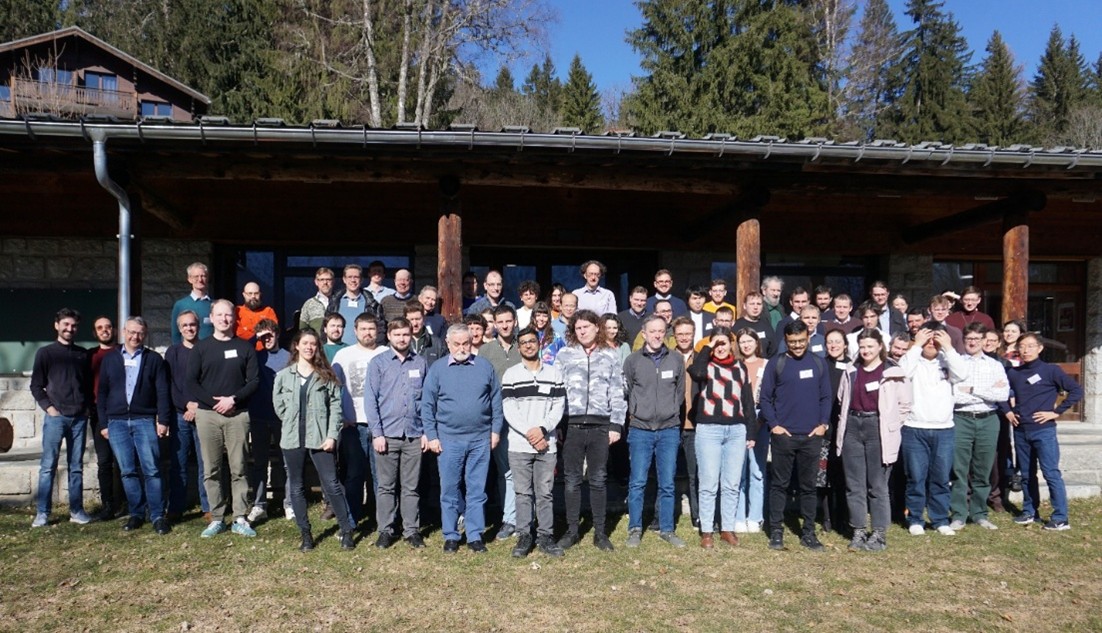
Padėka: Dalyvavimas konferencijoje ir joje pristatyti tyrimų rezultatai buvo finansuojami Lietuvos mokslų tarybos (LMT projekto Nr. S-MIP-23-31).
2025-07-04
Birželio 29 – liepos 2 d. Vengrijoje Gárdony miestelyje vykusioje konferencijoje „Photosynthesis: from Fundamental Mechanisms to Applications“ susirinkę mokslininkai iš viso pasaulio dalinosi savo naujausiais rezultatais fotosintezės srityje: nuo fundamentinių tyrimų nustatant šviesos sugerties ypatumus ir elektroninių sužadinimų pernašos mechanizmus iki augalų biosintezės, biomasės akumuliavimo ir kitų taikomųjų darbų apžvalgos. FTMC Molekulinių darinių fizikos skyriui atstovavo doc. dr. Jevgenij Chmeliov, skaitęs pranešimą apie tarpmolekulinių krūvio pernašos būsenų susidarymą pirmosios fotosistemos šviesorankos antenoje.
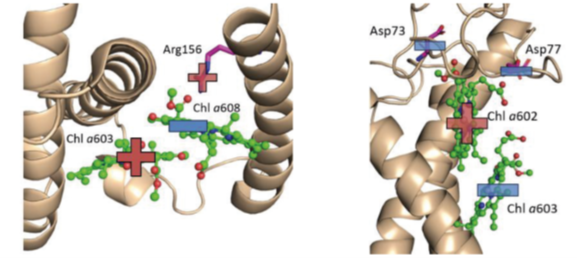
Padėka: Konferencijoje skaitytame pranešime pristatyti tyrimai finansuoti Lietuvos mokslų tarybos (LMT projekto Nr. S-MIP-23-31).
2025-10-05
Rugsėjo 29 – spalio 3 d. Vilniuje vyko tarptautinė konferencija „Extended Hanseatic Workshops on Exciton Dynamics and Spectroscopy (EEDS 2025)“, subūrusi Baltijos regiono tyrėjus ir doktorantus, nagrinėjančius eksitonų dinamiką ir relaksaciją įvairiose molekulinėse sistemose. Prie konferencijos organizavimo prisidėjo FTMC Molekulinių darinių fizikos skyriaus darbuotojas doc. dr. Jevgenij Chmeliov, savo pranešimus konferencijoje skaitė prof. habil. dr. Leonas Valkūnas („Fuorescence Variability of Stilbene Aggregates and Heterostructured Films“), dr. Andrius Gelžinis („Fourth Order Corrections for Absorption Calculations with Complex Time-Dependent Redfield Theory“) bei doktorantė Gabrielė Rankelytė („Impact of the Protein Environment on the Excited States of the Pigments in Photosynthetic Complexes“). Konferencijos metu buvo suorganizuota specialiųjų mokymų sesija, skirta doktorantams ir podoktorantūros stažuotojams.
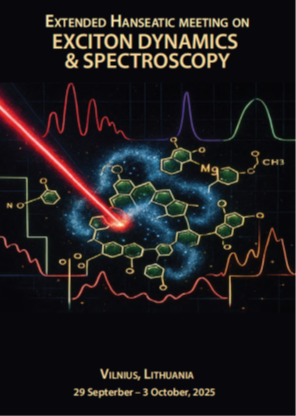
Padėka: Konferencijoje skaitytuose pranešimuose pristatyti tyrimai dalinai finansuoti Lietuvos mokslų tarybos (LMT projekto Nr. S-MIP-23-31).